Showing posts with label lantana. Show all posts

Monday, June 22, 2015

More than an itch, part five

Near the leaf-footed bug nymphs on the lantana were a couple of my favorite bug nymphs.  As adults, they look like typical bugs, but as nymphs they look remarkably like ants!

A broad-headed bug (Alydidae) nymph.
Nevertheless, they can be distinguished easily from real ants (such as the one pictured below) if you know where to look.  Despite mimicking an ant's appearance in many ways, these nymphs still have the long mouthparts characteristic of bugs.

A carpenter ant (Camponotus sp.).
The ant mimics also don't act much like ants.  When they are approached, they quickly run for cover and unlike some other bug nymphs, they aren't quick to return.

The ant mimic scurries away.

Friday, June 19, 2015

More than an itch, part four

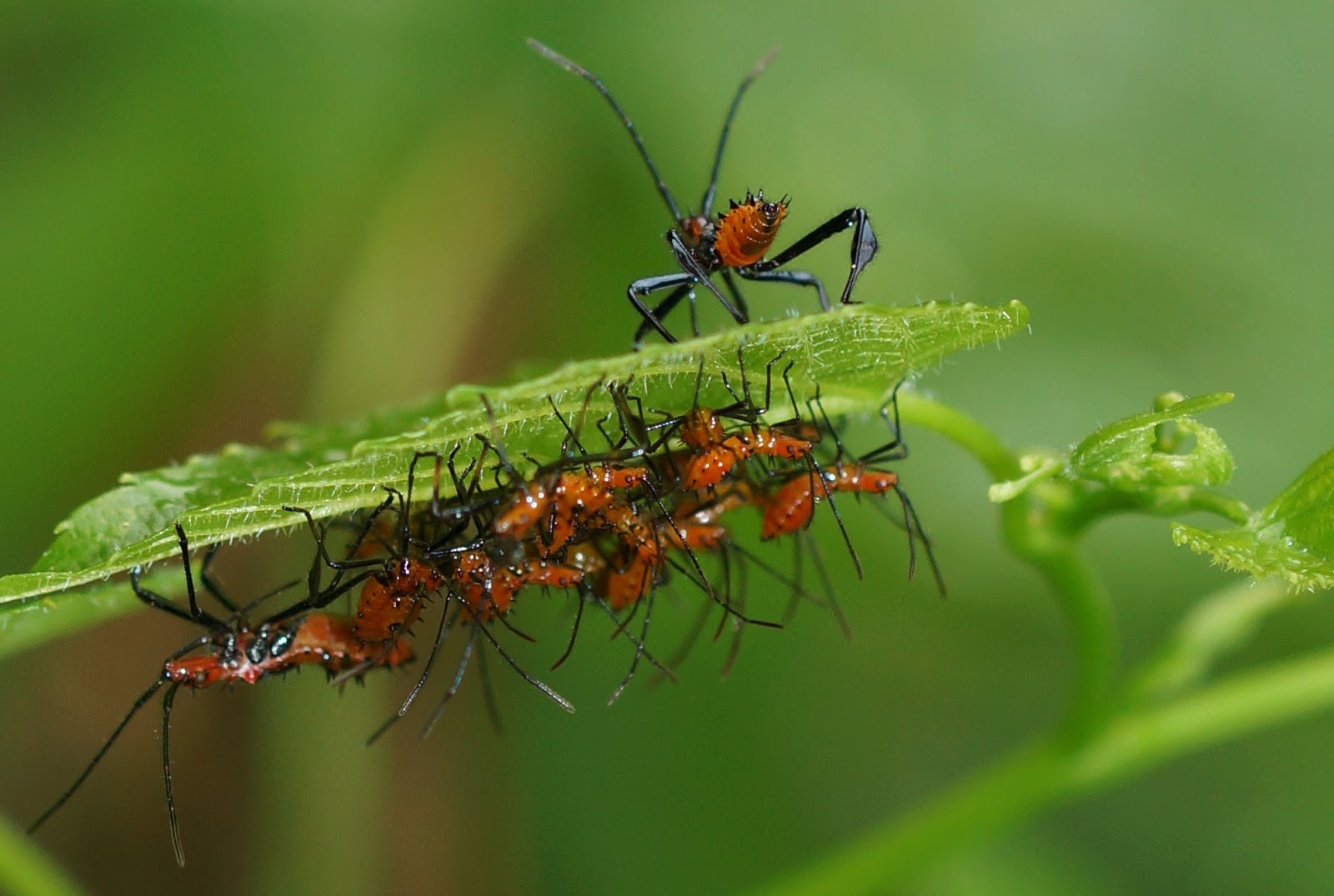
Like the bordered plant bug nymphs, leaf-footed bug nymphs are often found gathered in groups.  Therefore, the bug nymph pictured below appears to be unusually alone.

A leaf-footed bug nymph (Coreidae) on a lantana leaf.
However, looking from another angle reveals that the "lone" bug nymph is actually just the tip of the iceberg of bug nymphs!

Many more leaf-footed bug nymphs hanging underneath the leaf.
The large group of bug nymphs shared the limited space on the underside of the leaf peacefully.  However, another group feeding on unripe lantana berries nearby was not nearly so tranquil.


As I watched, an extended fight broke out between two of the nymphs.  They may have been competing over access to the berries.  Yet, there seemed to be plenty of berries available, which should have made a fight unnecessary.  An alternative explanation is that one of the nymphs may have tried to switch from eating berries to eating the other nymph, as some bug species are known to be cannibalistic.

Friday, March 27, 2015

Springing to life, part two

Instead of visiting the bluebonnets, many of the butterflies that I saw this weekend were gathered around several large lantana bushes.

A fiery skipper (Hylephila phyleus) on lantana flowers.
Some of the butterflies, such as the fiery skipper above and the red admiral below, remained focused on the flowers despite the approaching camera (and camera wielder).

A red admiral (Vanessa atalanta).
However, a couple of other species were consistently more challenging to approach.  Common buckeyes have the tantalizing tendency to fly just a few feet away each time I get almost close enough for a good shot (which has led to several very low-speed chases).

A common buckeye (Junonia coenia).
Meanwhile, with cloudless sulfur butterflies, I would have only one chance to approach as non-threateningly as I could.  If disturbed, these butterflies would nearly always disappear off into the woods...

A cloudless sulfur (Phoebis sennae).
...and they were very easily disturbed!

The cloudless sulfur dropping backwards off the flowers in order to fly away.

Monday, January 5, 2015

The host with the most, part two

The mining flies and galling mites inflicted peculiar injuries to the lantanas, but last year I saw plenty of ordinary herbivory of lantanas too.  Of course, after finding evidence of herbivory, I sought out the herbivores themselves.

A lantana leaf fastened in half by silk.
When the damage was fresh, I did not have to look far before finding the herbivore.  One type of caterpillar, the lantana leaftier moth, made pouches out of the lantana leaves by tying them with silk.  It then consumed the leaf down to a membrane while remaining concealed within the folded leaf (until I came along and pulled the leaf open).

A lantana leaftier moth (Salbia haemorrhoidalis) caterpillar eating the leaf from within.
Another, much larger caterpillar made an even more complete meal of the lantana leaves.  After it had finished with a leaf, there was often not much left besides the tough central vein.

A lantana after a visit from a very hungry caterpillar.
Looking for the first relatively intact leaf adjacent to the consumed leaves, it was easy to find the lantana moth caterpillars that were responsible for the devastation.

A lantana moth (Diastema tigris) caterpillar underneath a lantana leaf.

Monday, December 22, 2014

The host with the most, part one

The bright, multicolored flowers of lantanas attract many insects to feed on the nectar they dispense.

A gulf fritillary (Agraulis vanillae) visiting lantana flowers.
However, a number of other insects specialize on extracting nutrients from lantanas in other, more destructive ways.  Recently, I observed many lantana leaves that had been hollowed out, particularly along and around the veins.

A mined lantana leaf.
Although I did not see any of the leaf miners themselves, the pattern of damage was characteristic of the herringbone leaf-mining fly.

More lantana leaves mined by the larvae of the herringbone leaf-mining fly (Ophiomyia camarae)
Meanwhile, other lantanas were suffering from an even stranger affliction -- they had thick growths of miniature stems and leaves where they should have had flowers and fruits.

Lantana flower gall mites (Aceria lantanae) made this plant produce tiny stems and leaves in place of flowers.
In this case, bud mites were the culprits.  The mites had manipulated the plants into switching from producing flowers to growing more vegetative tissue, which had developed into galls enclosing the mites.