Last summer, I kept seeing song sparrows and gray catbirds coming in and out of a dense patch of rosebushes.
A song sparrow (Melospiza melodia) emerging from the rose bushes.
I guessed that they had built nests somewhere deep inside. Although I eventually found the song sparrow nest, I was disappointed that I could not locate the catbird nest. So, as a surprise, my mother put a wooden egg in an old nest and left it for me to stumble upon.
A large, blue egg in a nest. (Not a real egg.)
However, something else found the egg first.
When I heard crows squabbling, I looked out and saw that one of the crows was sitting on the ground by the rosebushes and attempting to eat what appeared to be a gray catbird egg. Of course, not knowing that a wooden egg had been placed outside just minutes before, I assumed that the crow had found and raided the catbird nest. The truth only emerged when I shared the sad news about the catbird nest with my mother. She quickly led me to the nest where the wooden egg had been. As she had suspected, the nest was empty. When the wooden egg finally reappeared in the yard several days later, it was in splinters. (The photograph of the egg in the nest above showed a reenactment using a spare egg. We immediately brought that second egg back inside!)
The crows were not the only ones to raise an alarm that a fox was about. At least one American red squirrel occasionally joined in with its high-pitched voice.
A young American red squirrel (Tamiasciurus hudsonicus).
Together, the crows and squirrel would make such a clamor that it would have been difficult to ignore even if I hadn't already become attuned to the crows. Hearing the alarm, I would grab my cameras and rush to the nearest vantage point -- in this case, the balcony:
* To see this video in high definition (1080p), you may need to:
(1) click "YouTube" to watch on the YouTube website
(2) change the settings at the bottom of the video screen
I watched the video several times before I noticed that it features not one, but two squirrels. There is the American red squirrel calling noisily in the background, as well as a much less vigilant gray squirrel behind the ferns. If you watch the top of the video very closely, you can see can see it moving towards the fox. Once the fox gets to the edge of the ferns, the gray squirrel turns to escape and the fox takes up chase. To be continued...
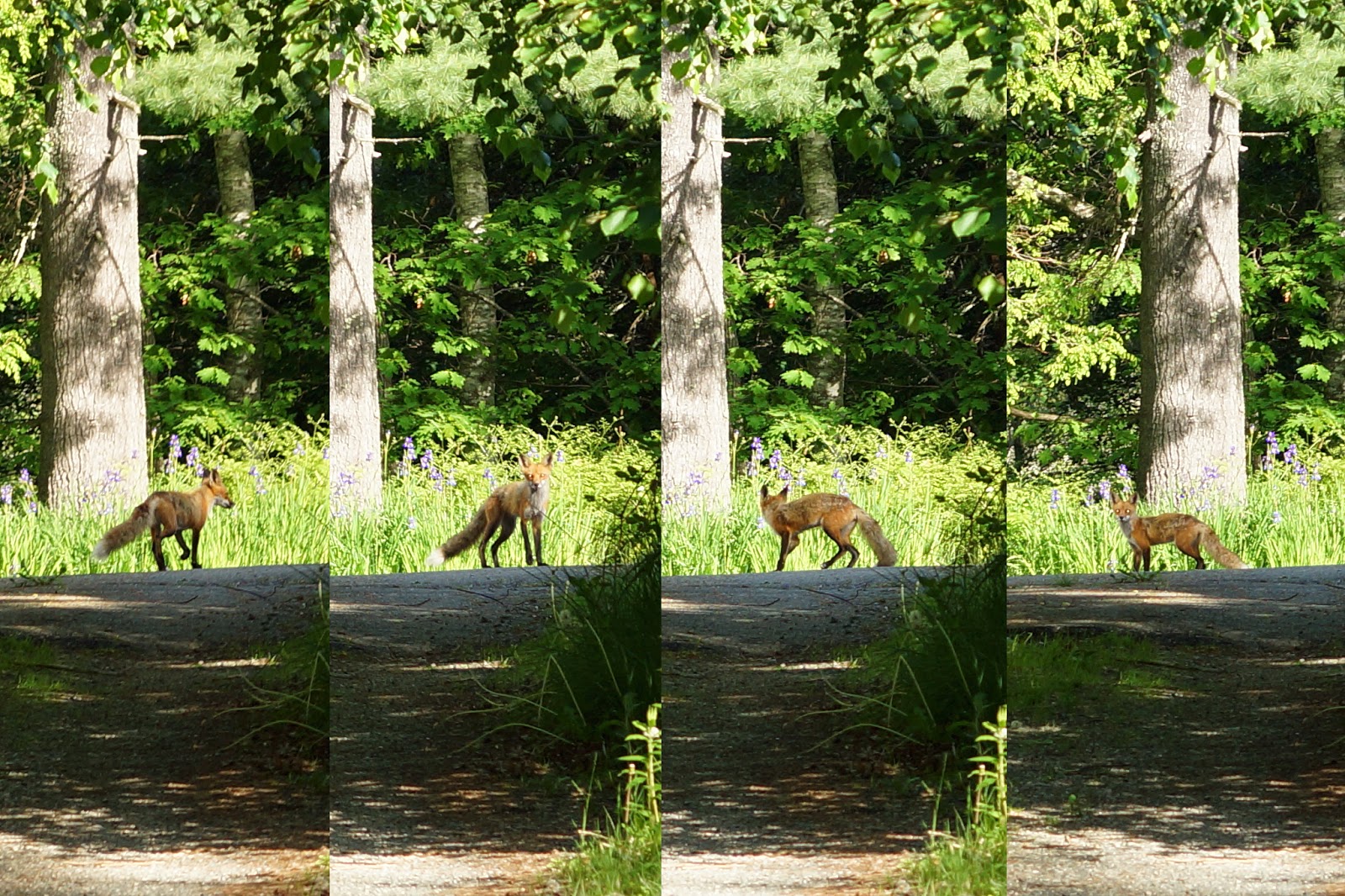
A few days after I arrived in Maine this summer, I heard that there were foxes in the neighborhood. Since I had heard about the foxes before -- but failed to find them -- I wasn't very optimistic about my chances this year either. However, my expectations could hardly have been more wrong. I saw one of the foxes the very next time I went outside!
An early encounter with one of the neighborhood foxes. When I yelled out "fox!", it startled me by turning back and taking several steps toward me.
Moreover, encountering the foxes became a regular occurrence. At first, it was a matter of being in the right place at the right time. But then, I discovered how to locate the foxes with high reliability -- by following the sound of the crows.
* To see this video in high definition (1080p), you may need to:
(1) click "YouTube" to watch on the YouTube website
(2) change the settings at the bottom of the video screen
Usually, the crows would 'caw' just three or four times before pausing. Therefore, when I heard them calling continuously (and harshly even for crows), I went to investigate. The crows were perched up in a tree looking down at tall grass. A few moments of scrutinizing the grass revealed a fox gazing back at me. When the fox dashed off, the crows flew after it, still cawing. After that, the crows became my fox alert system. They nearly always led me to a fox, although there were a couple of easily forgivable false alarms triggered by a bald eagle flying overhead and a falcon chasing a baby squirrel around a tree.