Showing posts with label lamb's ear. Show all posts

Monday, November 12, 2012

In the pink

Leafhoppers are a common sight in the garden, yet I rarely consider writing about them.  One reason is that I never see them do very much.  They feed on plant sap and, consequently, spend most of their time sitting still on plants.

A privet leafhopper (Fieberiella florii) on a rose bush.
The exception is when they are provoked (for example, by my camera getting too close).  Then, they can jump a very impressive distance for an insect called only a "hopper".  However, this interesting ability is difficult to capture with the camera.

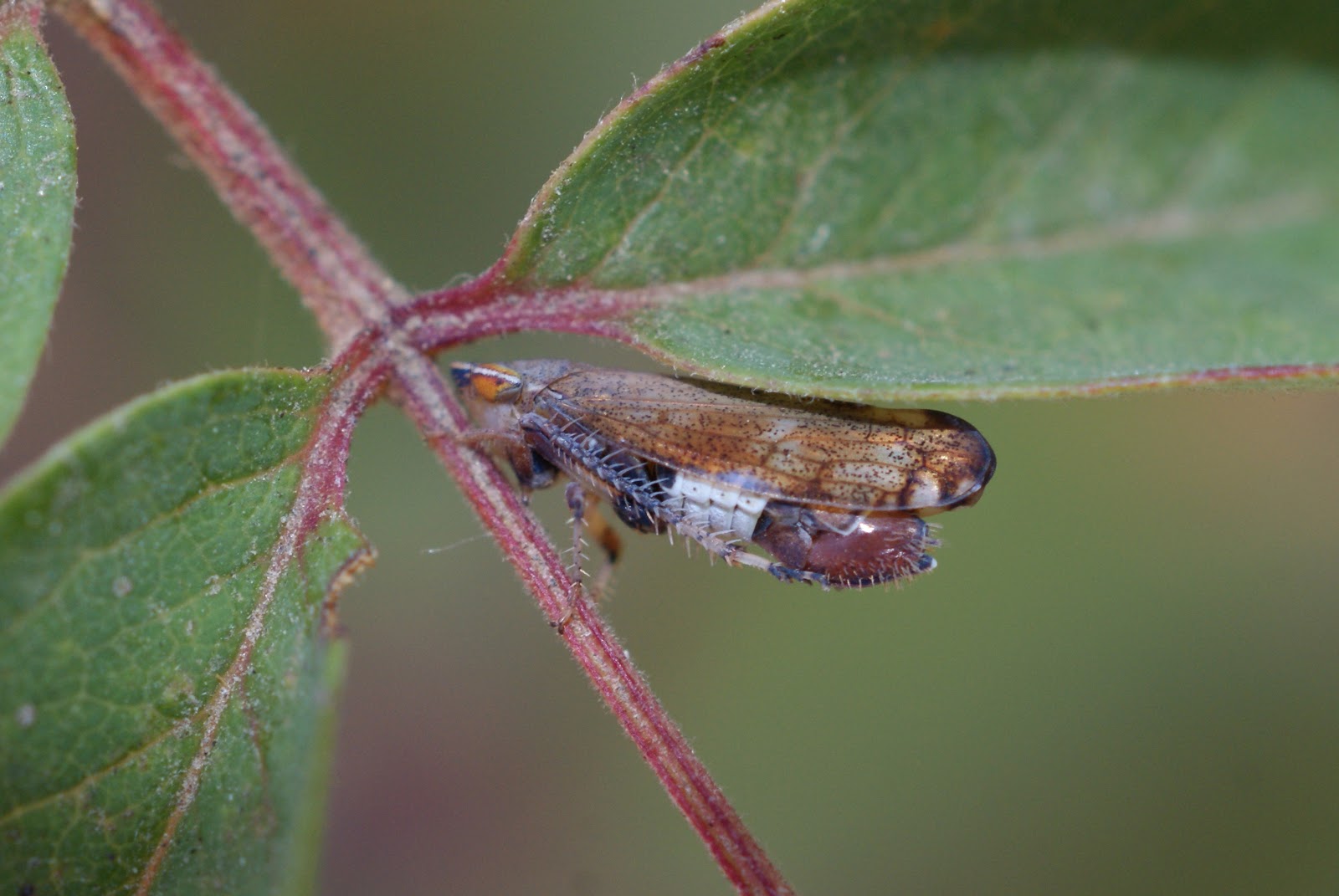
A froghopper on a lamb's ear leaf shortly before it escaped the camera.
Another reason to overlook the garden hoppers is their dull coloration.  Until last week, all the hoppers I had found in my garden were some sort of brown, such as the ones pictured above.  Thus, I was very surprised to find a bright pink hopper when I was clearing away fallen leaves.

A pink leafhopper that I uncovered under some leaf litter.
Some leafhoppers are pink as adults, but the one pictured above doesn't match the descriptions I have found.  Another possibility is that it had just gone through its final molt and had not yet darkened to its adult color.

Thursday, August 23, 2012

The egg snatchers

Summer is ending and there are fewer flowers blooming in the garden.  As a result, the foliage gets more of my attention.  It may not be changing color yet, but it is covered with insect and spider life.  Earlier this week, I noticed several clusters of small eggs on lamb's ear (Stachys byzantina) leaves and on grass.


I was curious to know what had laid all these eggs.  Although most of them had already hatched, I did not see any insects nearby nor any damage to the leaves from hungry young insects.  Therefore, when I found a cluster with about half the eggs still unhatched, I decided to keep the eggs in a jar and observe what emerged. 

The leaf and eggs in my "incubation chamber": a jam jar with a damp paper towel.
The next morning, I saw my first hatchling -- but it was not the offspring of whatever had laid the cluster of eggs.  Instead, it was a parasitoid wasp.  Some time ago, this wasp must have hatched from an egg laid inside one of the already small eggs visible in the picture below.  It then grew, consuming the insect that was developing in the surrounding host egg. 

A parasitoid wasp emerged from one of the eggs.
Two more days have passed and the first wasp has been joined by several more wasps.  Nearly all the eggs have hatched, but I am no closer to finding out what laid them!