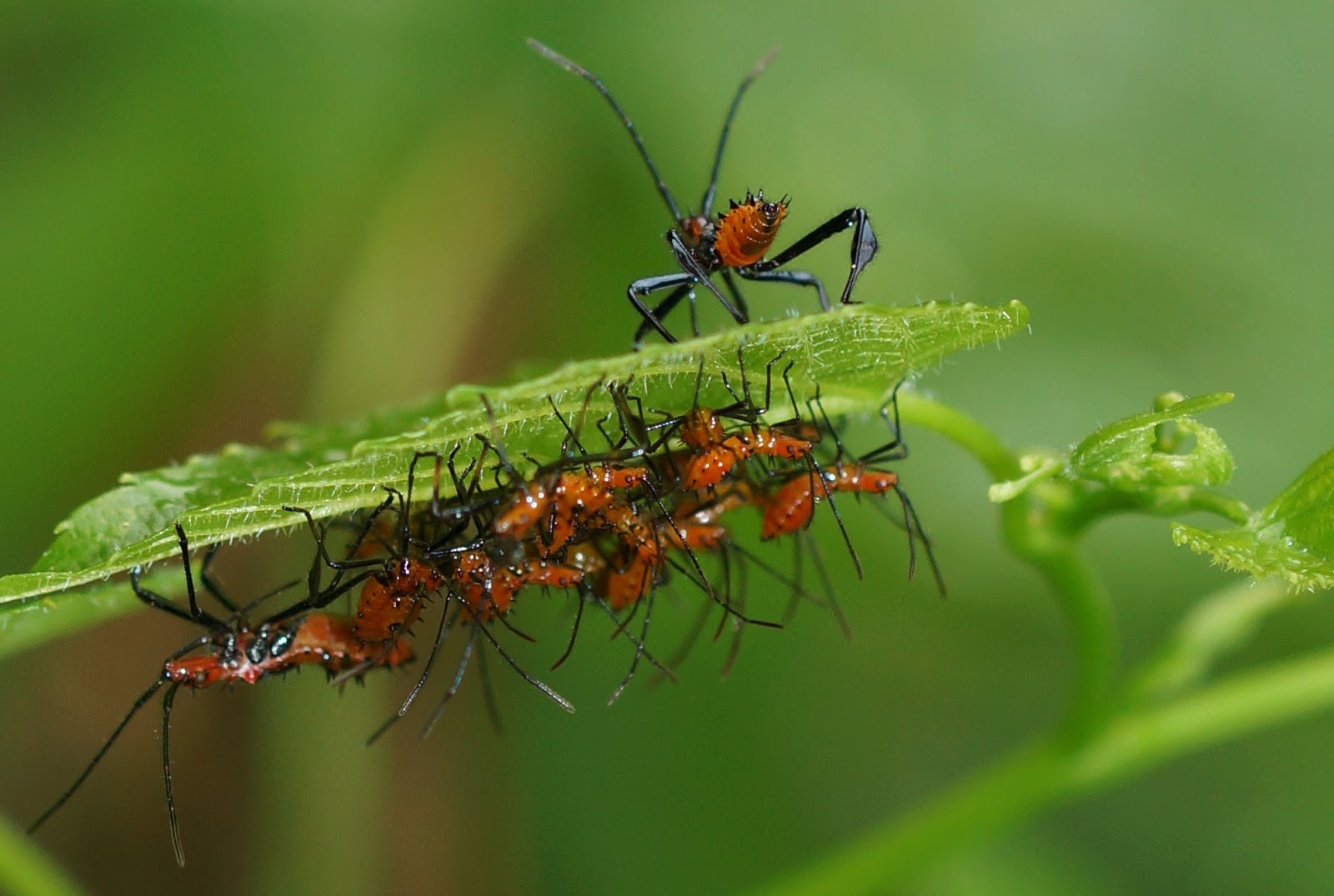
Like the bordered plant bug nymphs, leaf-footed bug nymphs are often found gathered in groups. Therefore, the bug nymph pictured below appears to be unusually alone.
A leaf-footed bug nymph (Coreidae) on a lantana leaf.
However, looking from another angle reveals that the "lone" bug nymph is actually just the tip of the iceberg of bug nymphs!
Many more leaf-footed bug nymphs hanging underneath the leaf.
The large group of bug nymphs shared the limited space on the underside of the leaf peacefully. However, another group feeding on unripe lantana berries nearby was not nearly so tranquil.
As I watched, an extended fight broke out between two of the nymphs. They may have been competing over access to the berries. Yet, there seemed to be plenty of berries available, which should have made a fight unnecessary. An alternative explanation is that one of the nymphs may have tried to switch from eating berries to eating the other nymph, as some bug species are known to be cannibalistic.
The glossy privets in the park are now drooping with large clusters of dark berries. Curious whether anything was feeding on the berries, I inspected several bunches. Although I did not find any sign that the berries were being consumed, I did discover one animal that had found another use for the berries: as a shelter.
A spider wedged in amongst a bunch of glossy privet (Ligustrum lucidum)berries.
While I was in Florida, I witnessed a very different midwinter's feast than that enjoyed by the flocks of birds here in Eastern Washington. There, the fare was a bounty of bright red fruits, freshly ripened on the Christmas palms (Adonidia merrillii).
Ripe fruits of a Christmas palm (Adonidia merrillii).
However, during the day, these fruits did not seem to attract any attention from consumers. It was only at night, while I was out searching for frogs, that I heard noises coming from the vicinity of the fruits. Looking up, I caught a brief glimpse of a furry body as it scrambled away through the canopy. I thought it
might have been an opossum, since we had seen them in the yard in previous
years. The next night, I spooked the creature again before I could get a better look. Finally, on the third night, I approached the trees more cautiously -- and saw that the creature was definitely not an opossum.
* To see this video in high
definition (1080p), you may need to (1) click "YouTube" to watch on the
YouTube website and (2) change the settings at the bottom of the video
screen.
The creature that had been feasting on the palm fruits each night was a rat. Although the poor lighting makes it difficult to see many distinguishing features, the rat looks (at least to me) more like an Eastern Woodrat (Neotoma floridana) than any of the other rodents listed as living in Florida. The only problem is that the species is thought to be locally extinct this far south in the state!
During the fall, I would frequently check on the crabapples to see if anything was eating them. However, back then, they did not appear to be appetizing to anything except coddling moth caterpillars. Finally, now that it is the middle of winter and there is very little else to eat, the crabapples are attracting more interest.
Crabapples, some partially eaten, covered in frost after a freezing fog.
Over the past couple of weeks, I have seen large flocks of birds, including house finches (Carpodacus mexicanus), occupying the crabapple tree and eating the fruits.
A female house finch (Carpodacus mexicanus) picking a crabapple.
The birds are messy eaters and have littered the ground below the tree with bits of fruit. These bits, in turn, have been attracting flightless consumers: rabbits, rodents, or both. Nevertheless, the crabapples are not the top choice for all the animals visiting the yard. When a flock of cedar waxwings (Bombycilla cedrorum) appeared this weekend, they ignored the crabapples and feasted on the many juniper berries that had also been left uneaten since last summer.
* To see this video in high
definition (1080p), you may need to (1) click "YouTube" to watch on the
YouTube website and (2) change the settings at the bottom of the video
screen.
Fruits all over the garden have finally ripened to a vibrant red. There are crabapples, rowan berries, rosehips, trumpet honeysuckle fruits, and cotoneaster fruits (pictured below) -- all of which add attractive autumn color to the garden.
Berries and autumn foliage of a Cotoneaster sp. shrub.
The bright color of the fruits is not only appealing aesthetically; it also attracts seed dispersers, such as birds, that consume the fleshy fruits but fail to digest the seeds within. However, not every red thing on the branches is aiming to be eaten. Spot the exceptions in the photo below!
Two seven-spotted ladybugs (Coccinella septempunctata) among the Cotoneaster sp. berries.
Interestingly, in the case of the ladybugs, the red color serves as a signal that they are distasteful.