Showing posts with label fly. Show all posts

Monday, December 22, 2014

The host with the most, part one

The bright, multicolored flowers of lantanas attract many insects to feed on the nectar they dispense.

A gulf fritillary (Agraulis vanillae) visiting lantana flowers.
However, a number of other insects specialize on extracting nutrients from lantanas in other, more destructive ways.  Recently, I observed many lantana leaves that had been hollowed out, particularly along and around the veins.

A mined lantana leaf.
Although I did not see any of the leaf miners themselves, the pattern of damage was characteristic of the herringbone leaf-mining fly.

More lantana leaves mined by the larvae of the herringbone leaf-mining fly (Ophiomyia camarae)
Meanwhile, other lantanas were suffering from an even stranger affliction -- they had thick growths of miniature stems and leaves where they should have had flowers and fruits.

Lantana flower gall mites (Aceria lantanae) made this plant produce tiny stems and leaves in place of flowers.
In this case, bud mites were the culprits.  The mites had manipulated the plants into switching from producing flowers to growing more vegetative tissue, which had developed into galls enclosing the mites.

Monday, November 10, 2014

Falling back, part two

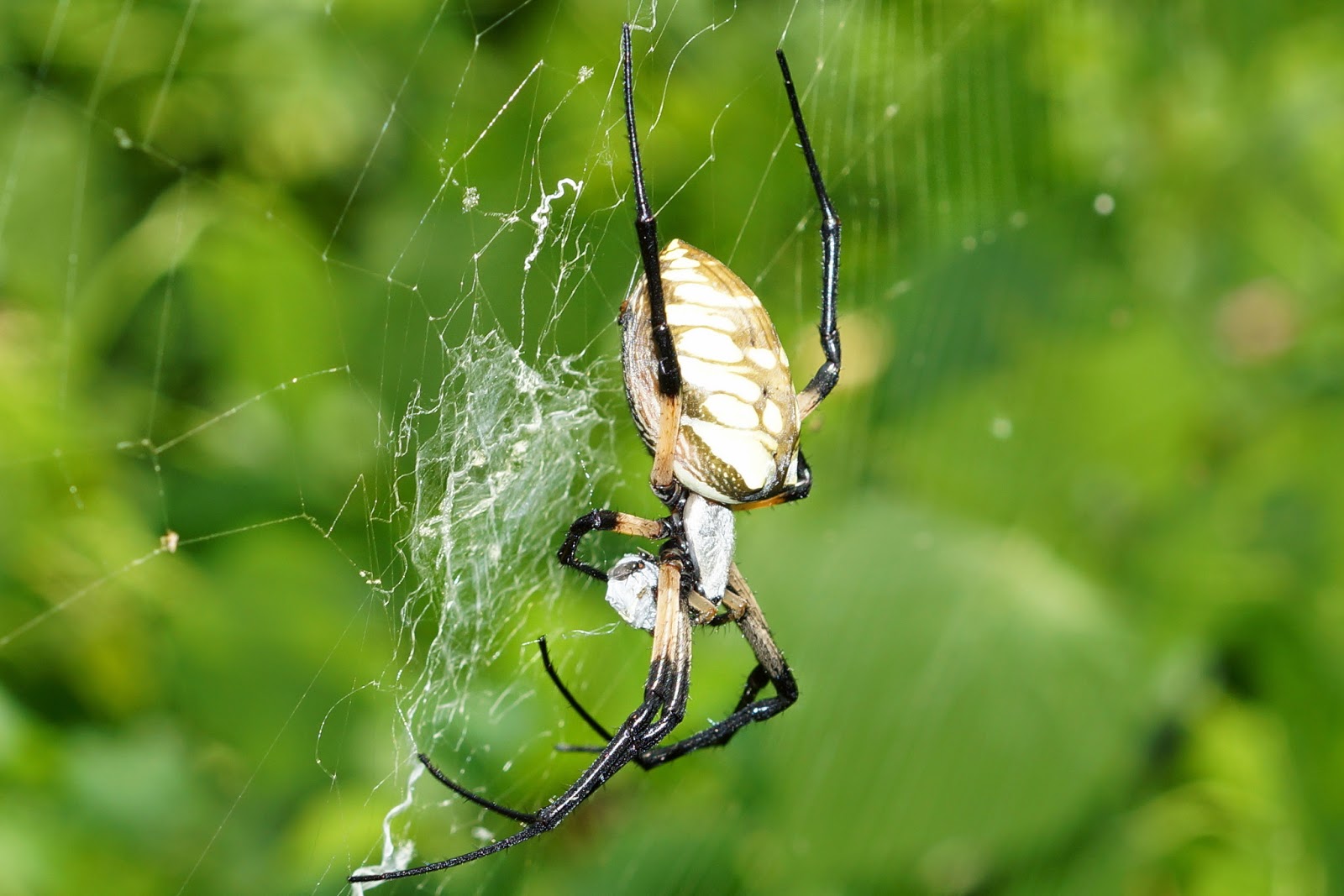
Although the wasp kept its distance, other insects were more willing to get close to the spider in order to get a meal.  See if you can find them in the picture below.

The black-and-yellow argiope (Argiope aurantia) spider and its prey.
If they are too small to find in the picture above, this close-up should help.

Two small flies are sitting on the spider's wrapped-up prey.
The spider is clutching a prey item already wrapped in white silk -- and if you look closely on the left and top of the white package, you can see two very small flies.  These appear to be freeloader flies (Milichiidae), which are often found in the seemingly hazardous occupation of feeding on the kills of spiders and other predators.

Friday, July 11, 2014

A sticky situation

Even when the beaver ponds are empty of beavers, they are home to a wide diversity of other inhabitants.  Insects are especially numerous -- and where insects abound, so too can their consumers.  In particular, the beaver ponds provide an excellent habitat for carnivorous plants, such as pitcher plants and sundews.

A patch of sundews (Drosera sp.).
Around some of the beaver ponds, the sundews form a red carpet that is both enticing and deadly (at least for insects).

A close-up of the leaves with their sticky tentacles.
Each small sundew leaf is studded with dozens of red tentacles, each of which ends in a dewy ball that glistens in the sunlight.

Another view of the leaves.
These sweet droplets attract insects near, then stick to and engulf any hapless insect that comes into contact with them.

A crane fly (Tipuloidea) caught by the sundew.
Insects trapped in this way are digested by the plant, providing an important supplement to the boggy, nutrient-poor soil.

Friday, July 4, 2014

Happy Fourth (Crab Spider)!

Happy Fourth of July!  To celebrate the date, here is a picture with four crab spiders, including one happy spider with a fly.

Can you find all four crab spiders?
In case you had any trouble spotting all the spiders, here is the picture again, with the spider locations marked...

Three female and one male Misumena vatia crab spiders.
 ... and here is a closeup of the happy spider with her large meal.

The most successful of the four spiders, eating a fly.

Wednesday, May 28, 2014

Camera shy

A metallic fly on a sunlit leaf should make an attractive picture.  Yet getting such a picture poses a serious challenge.  It is not that the flies are rare, since I often come across gleaming blue, green, and even gold flies perched in the sun.  It is not that they fly away either.  The flies sit still as I line up my camera and are still sitting on the leaves once the pictures have been taken.  However, the flies do not appear in the pictures themselves.

A leaf where a fly had been sitting a moment before.  If you look closely, you can find two of the fly's legs.
In between the time that I press the shutter button and the time that the picture is taken, the flies reliably launch themselves off their leaves, only to land again the next moment.  This amazing disappearing act is possible because flies have extremely fast reaction times.  As soon as the camera begins to flash, the targeted fly initiates its evasive action.  Nevertheless, the flies are not impossible to catch on camera (even when continuing to use the flash).  With some experimentation, it is even possible to capture them in midair.


After many tries, I was also able to take a picture of the fly sitting on the leaf.  Perhaps I had momentarily worn the fly down or the angle of the shot had caught the fly by surprise.

A sneak attack from the rear finally succeeds in capturing the longlegged fly (Dolichopodidae, subfamily Sciapodinae).
 Either way, the fly soon returned to its shy ways.

Can you find the fly's shadow?
Explore some more: Why Flies Are So Hard to Swat

Friday, January 10, 2014

The fallen monarchs

Last winter, we found a monarch chrysalis that had fallen to the ground.  We brought it inside and several days later the story ended happily as the monarch successfully emerged and took flight.  This winter, falling was still a danger -- my mother found two chrysalises on the ground -- but there were also more serious threats lurking in the garden.

The remains of a caterpillar that had begun to form a chrysalis.
When I arrived in Florida and surveyed the garden, the only monarchs that I found were a caterpillar that had died while metamorphosing into a chrysalis (possibly due to disease or parasitism) and a chrysalis that did not look much healthier.

Something seems to have gone wrong for this monarch chrysalis.
The chrysalis was a dark brown color instead of bright green.  Although a healthy monarch chrysalis should turn dark shortly before the butterfly emerges (see here), something was wrong in this case -- the monarch's wing pattern was not visible.

A few days later, the chrysalis was still intact... but empty.
After a few days, the chrysalis was hollow with no obvious sign of what had happened to the butterfly that had been developing inside.  Meanwhile the chrysalises that my mother had rescued from the ground were also brown and hollow.  What had happened to all the monarchs? 

Pupae (left) from the flies that parasitized this monarch chrysalis (right).
Looking in the container below the rescued chrysalises, we found several pupae. These pupae belonged to flies -- flies that had parasitized the chrysalises and then emerged instead of the butterflies.  Unfortunately, since the container was not sealed, the adult flies had already escaped.

Monday, October 7, 2013

More than a pain in the neck, continued

After noticing the pattern in how candy stripe spiders tackle their prey, I decided to look back at my many pictures of crab spiders for comparison.  As I had thought, the crab spiders also frequently bit their prey just behind the head.

A female Misumena vatia crab spider eating a tricolored bumble bee (Bombus ternarius) in 2012.
The crab spiders took a different approach, however, when their prey was a hover fly (Syrphidae). 

A juvenile crab spider eating a hover fly (Syrphidae) in 2012.
In these cases, as illustrated in the pictures above and below, the crab spider bit right into its victim's abdomen.

Another crab spider eating a hover fly, this time on a snapdragon.
In addition to having a soft abdomen, hover flies are relatively easy for crab spiders to catch.  One way for hover flies to compensate for their vulnerability is to spend more time inspecting landing sites for potential danger; indeed, hover flies can often be seen seemingly suspended in the air above flowers before touching down to feed or darting quickly away.

Two hover flies inspecting a flower before landing.

Friday, September 27, 2013

Winsome invaders, lose some invaders

Of the thousands of invasive Japanese beetles that I see each summer, a small number have white ovals stuck to them.  These white ovals, which are the eggs of the parasitic "winsome fly" (Istocheta aldrichi), are usually attached to a beetle's pronotum (just behind the head) or sometimes to its elytra (the hard coverings over the wings).  Although the eggs do not look like much, they mean that the beetle has only a few more days to live.

Mating Japanese beetles (Popillia japonica); these beetles are unlikely to have any offspring, however, since the female has several winsome fly (Istocheta aldrichi) eggs glued to her.
About a day after the eggs are laid, larvae hatch from them and bore into their beetle host.  After a few more days, the beetle dies, eaten from the inside by the fly larvae.  Like the Japanese beetles themselves, winsome flies were introduced into North America from Japan.  Unlike the Japanese beetles, the flies were introduced intentionally -- in the hope that they would restrict the growth of the Japanese beetle populations.  However, it has now been more than 90 years since the flies were first introduced, and the Japanese beetle remains a growing problem.

Explore Some More: Biological Control of Japanese Beetles

Monday, September 23, 2013

Unafraid to be yellow

Most of the crab spiders that I find are white.  Not only do I find white crab spiders on white flowers, I also find them on pink, purple, red and blue flowers.  The exception is on yellow flowers, where the crab spiders tend to be a matching yellow.  Therefore, when I found a white crab spider hunting on the very yellow flowers of a goldenrod, I decided to keep track of it for the next few days.

Day 1: A white crab spider on yellow goldenrod flowers.
On the first day that I observed it, the white crab spider was doing quite well for itself despite not matching the color of the flowers.  It had caught a large fly, thus procuring for itself a substantial meal.

Day 3: The spider is pale yellow.
Notwithstanding its previous success as a white spider on a yellow flower, the spider had soon acquired a pale yellow hue.  After another two days, the crab spider had acquired both more yellow and another fly.

Day 5: The spider has caught another fly.
How had the crab spider turned yellow?  The color change was first triggered by the crab spider seeing yellow around it.  In response, the crab spider began to synthesize yellow pigments which it then kept in cells near the surface of its body.  (To return to white, the crab spider could move the yellow pigments away from the surface to be stored until needed again.)

Day 6: The spider is the same bright yellow as the golden rod flowers.
Why had the crab spider turned yellow?  Although the answer seems simple -- to hide from potential prey and predators -- studies of crab spiders have failed to find a benefit from either increased prey capture or decreased capture by predators.  Nevertheless, the metabolic cost of synthesizing the yellow pigments suggests that a benefit must exist (or at least one must have existed until relatively recently).

Friday, September 20, 2013

It's a fly eat fly world too

Spiders eat spiders.  Spiders eat flies.  So far, no surprise.  But did you know that there are some flies that eat other flies?

A robber fly (Asilidae) with another fly it has just captured.
These predatory flies are commonly --and rather euphemistically -- called "robber flies".  Robber flies (Asilidae) snatch flies and other insects in flight, inject them with a mixture of paralyzing and digesting enzymes, and then consume the liquefied remains.  Thus, they are also referred to by some by the more appropriate name "assassin flies".

Monday, September 16, 2013

Purple insect eater

In most consumer-resource interactions between plants and insects, the plant is the one that gets consumed.  However, a few groups of plants have been able to reverse the relationship.  Insects and other small animals come to these plants for a meal, only to become one themselves.

A purple pitcher plant (Sarracenia purpurea) in bloom.
One of these carnivorous plants, the purple pitcher plant (Sarracenia purpurea), lures visitors onto its leaves with colorful markings and nectar secretions.

Dead insects, including a moth, in a pitcher plant leaf.
Once on a leaf, visitors become trapped due to the leaf's waxy surface, steep angle, and downwards pointing hairs -- and possibly due to being drugged (a narcotic compound has been found in the secretions of a related species, S. flava).  Even flying insects fall into and then drown in the pool of rainwater at the base of the leaf.

Flies and springtails trapped in another leaf.
This water also contains digestive enzymes secreted by the leaf and a community of bacteria, which together break down the victims of the trap.  The leaf can then absorb nutrients that the plant might not otherwise be able to obtain from the poor quality soil in its boggy habitat.

A carabid beetle attempting to escape the pitfall trap.

Wednesday, August 28, 2013

Keeping the enemy closer

While I was out for a walk, I came across a spider that was even more notable for abstaining from eating flies than the jumping spiders on the roses had been.  This spider had flies walking all over it, yet it made no move to catch them.

Flies sitting on a crab spider as it waits in ambush.
The flies were not in blind spots (crab spiders have eyes facing forwards, sideways and backwards); nevertheless, they may have been in the safest spot around.  Though the flies were tantalizing close, the spider may not have been able to reach around to grab them.  Another possibility could have been that the spider was simply waiting for larger or more appetizing prey to come along.

A bigger prey is a better prey?
However, as I was quickly being left behind by the rest of my group, after watching for only a little while longer, I left the spider to its hunting and the flies to their death defying stunts.

Friday, August 9, 2013

A cradle of roses

As the rose hips ripen here in Maine, they are acquiring both a pretty red blush and quite a few pockmarks.  What has been causing these small scars on the surfaces of the rose hips?

A ripening rose hip with several small, dark wounds.
In the past, I had often seen rose hip flies (Rhagoletis basiola) sitting on and nearby the rose hips.  These flies did not seem to be doing much, though, except sometimes rotating their wings in what may be a mating display.  However, over the last few days, I have caught a couple of the flies in the act --

A rose hip fly (Rhagoletis basiola) ovipositing into a rose hip.
 -- puncturing the rose hips with their ovipositors and laying their eggs inside.

Another rose hip fly (Rhagoletis basiola) ovipositing into a rose hip.
When I waited for one of the flies to finish laying and leave, I saw a fresh hole in the rose hip.  Checking back the next day, I found that the hole had scarred over to match the many other pockmarks on the rose hip.

Friday, April 26, 2013

Game over

Sometimes, it is the flower that gets bitten by the visitor.  Other times, it is the visitor that gets bitten.

A small crab spider eats a fly on a wood anemone (Anemone nemorosa) flower.
After searching hundreds of flowers, I was excited not only to see my first crab spider in Germany, but also to find it complete with prey.  However, since I realize that not everyone feels that a spider improves a flower, here is a view of some of those that were spider-free.

A patch of wood anemones (Anemone nemorosa) where just a few days ago I had only seen dry leaves.

Monday, April 1, 2013

The scourge of the spurge

On my last day in France, I stumbled upon a small garden that I had visited once (also while wandering around a bit lost) almost six years before.  I remembered the garden as being full of bright flowers and buzzing insects, but on this cold spring day everything seemed green and still.  However, as I continued along the narrow path, I discovered that not all of the green was simply foliage.  All along the back of the garden, spurge (Euphorbia sp.) plants were topped with light green inflorescences full of little flowers...

One of the many flies that I found visiting the spurge (Euphorbia sp.) flowers.
... and also surprisingly full of large flies, given the lack of pollinators everywhere else I had looked.  I began to get my hopes up -- where I could find flies, I might also be able to find a spider.  A few plants later, there it was: a small spider, but with a good chance of growing larger very soon.

A small spider lurking amongst the spurge flowers.

Friday, November 30, 2012

Out of the gall and into the jar

When I opened the thistle gall, I exposed four Canada thistle stem gall fly (Urophora cardui) larvae. These flies can reduce the seed production, and thus the spread, of the invasive Canada thistle (Cirsium arvense).  Therefore, I decided to give the larvae a new home to replace their broken gall.  I put them into a jar, but had trouble deciding where to keep the jar.  I worried that the jar might not provide as much insulation as the gall, and thus that the larvae might freeze if kept outside.  However, inside the house it was warm; would the larvae take this as a cue that spring had arrived and pupate several months early? 

A larva (left) and three pupae (right) of the Canada thistle stem gall fly (Urophora cardui).
Five days later, three out of four of the larvae have pupated.  Perhaps their pupation was just triggered by the destruction of the gall, but I think it is likely that the warm temperature inside the house played an important role.  The next stop for the jar is the garage, where I hope the cooler temperature will halt their development until a more appropriate time.

Wednesday, November 28, 2012

Down with the thistles

Canada thistle (Cirsium arvense), an invasive species from Eurasia, is common in this area.  However, so too are its enemies.  Even though the thistles have died down for the winter, I have found several Canada thistle bud weevils (Larinus planus) in the yard.  These weevils seem to be seeking out spots where they can stay sheltered until the spring.

A Canada thistle bud weevil (Larinus planus) sheltering on the lavender bush.
Another of the thistles' enemies has found a very cozy way to spend the winter -- within galls on the thistles' own stems. 

A gall on a Canada thistle stem.
As I was clearing dead plants out of the garden, I came across a couple of dried thistle stems interrupted by these large galls.  I was curious to see what, if anything, was still inside.  Cutting open one of the galls, I found several very odd larvae.

Inside the gall there were several larvae of the Canada thistle stem gall fly (Urophora cardui).
The larvae did not have anything resembling legs or even heads.  They also failed to show any sign of life.  Thus, I initially thought that I must have cut them in half.  However, on closer inspection, I determined that they were all whole.  Although strange to me, this form is normal for Canada thistle stem gall fly (Urophora cardui) larvae at this time of year.  In the fall, the larvae finish growing and suspend their development.  Only in the spring will they pupate and then emerge from the gall as adult flies, ready to parasitize a new generation of thistles.