Showing posts with label spider. Show all posts

Friday, June 26, 2015

This place is hopping, part one

Here in Houston we've been having a bit of rain recently (to put it mildly).  As a result, the woodland near my apartment became more of a wetland.  Not only did puddles appear all around, but so did plenty of frogs and toads ready to take advantage of them.  There isn't much action in the video below, but you can hear the calls of several eastern narrow-mouthed toads (Gastrophryne carolinensis) competing to attract mates.


Many frogs and toads had apparently already been successful in attracting mates, as the puddles were swarming with tadpoles of various shapes and sizes.

The trail through the woodland -- turned into a tadpole spawning ground.
The puddles were also excellent breeding grounds for mosquitoes, so I hoped that the tadpoles were feasting on all the mosquito larvae.

One of the larger tadpoles.
Meanwhile, some other animals proved to be better at coping with the new landscape than might have been expected.

A spider walks across one of the plethoric puddles.

Monday, December 15, 2014

Browner than a berry

The glossy privets in the park are now drooping with large clusters of dark berries.  Curious whether anything was feeding on the berries, I inspected several bunches.  Although I did not find any sign that the berries were being consumed, I did discover one animal that had found another use for the berries: as a shelter.

A spider wedged in amongst a bunch of glossy privet (Ligustrum lucidum) berries.

Friday, November 14, 2014

Falling back, part three

The encounter that I observed between the black-and-yellow argiope and the wasp ended peacefully.  However, when I went to check on the spider a few days later, there was evidence that it had gone through a more violent confrontation in the interim.  Can you find what is missing in the picture below?

What is missing?
Either another predator targeted the spider or one of the spider's prey put up a fierce fight -- because the spider was down to seven legs.

Explore some more: Spiders Evolved Spare Legs

Monday, November 10, 2014

Falling back, part two

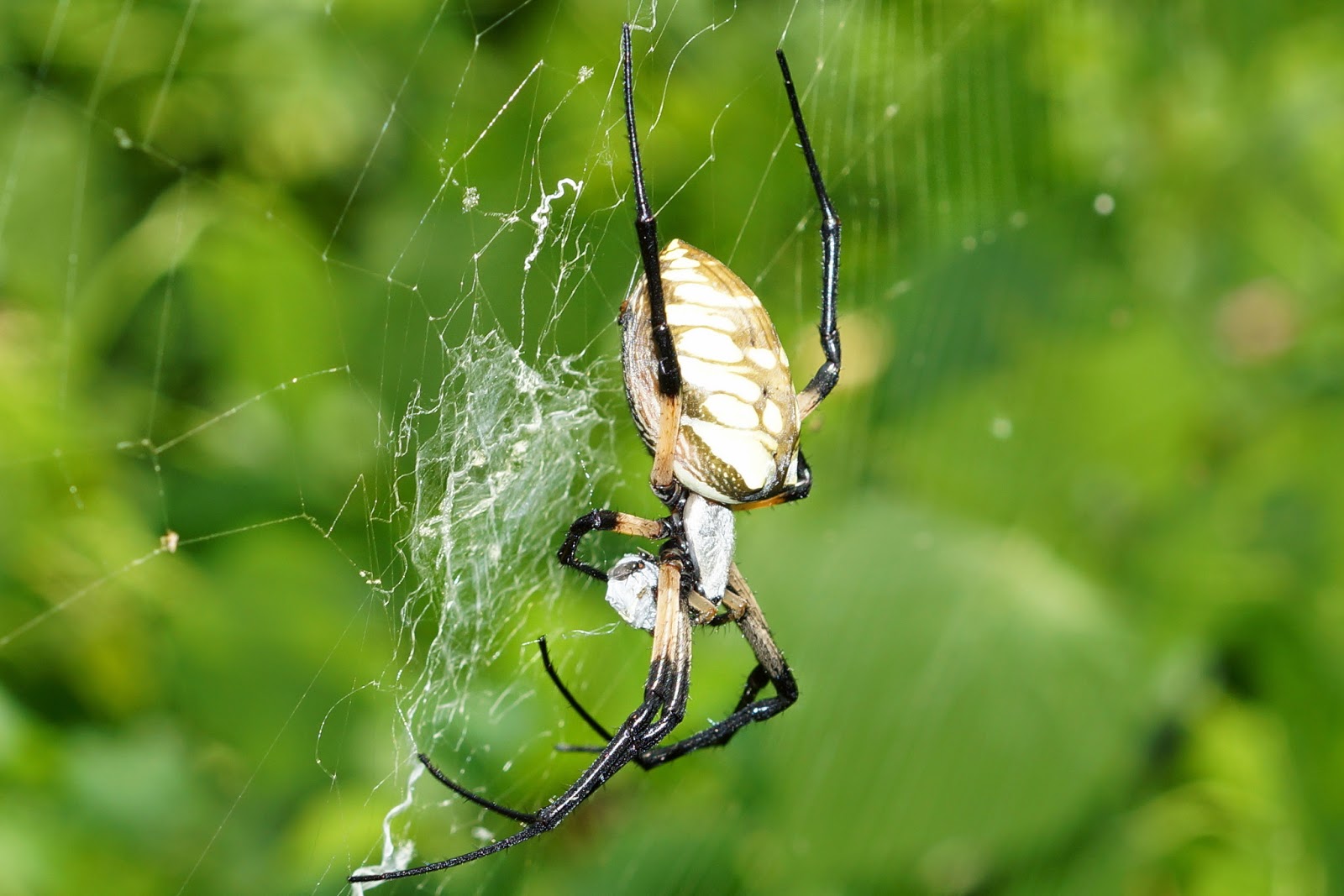
Although the wasp kept its distance, other insects were more willing to get close to the spider in order to get a meal.  See if you can find them in the picture below.

The black-and-yellow argiope (Argiope aurantia) spider and its prey.
If they are too small to find in the picture above, this close-up should help.

Two small flies are sitting on the spider's wrapped-up prey.
The spider is clutching a prey item already wrapped in white silk -- and if you look closely on the left and top of the white package, you can see two very small flies.  These appear to be freeloader flies (Milichiidae), which are often found in the seemingly hazardous occupation of feeding on the kills of spiders and other predators.

Friday, November 7, 2014

Falling back

Spiders can be predators of wasps, but sometimes the relationship is reversed and the spider becomes the prey.  This summer I watched a dramatic encounter that unfolded too quickly for me to capture on camera.  A spider was sitting on a leaf at the end of a tree branch while a large wasp hunted nearby.  As the wasp drew near, the spider edged away and then dropped down a thread to hang in mid-air.  For a few moments, it appeared that the spider had escaped the wasp's attention -- but then the wasp struck.  I had a brief glimpse of the wasp and spider grappling each other before they plummeted to the ground.  By the time they landed, the spider was already paralyzed or dead.

Not all spiders are so easily subdued, however.  Take, for example, the black-and-yellow argiope, one of the largest orbweaver spiders in North America (along with the giant lichen spider and the golden silk spider).

A black-and-yellow argiope (Argiope aurantia) orbweaver spider.
As I was photographing this very imposing spider, a wasp came up and hovered to inspect the spider too.

A wasp approaches the orbweaver spider.
If the disparity in size wasn't already enough to discourage the wasp from taking further action, a wave of the spider's legs seemed to complete the message.

The orbweaver spider waving its legs.
The wasp retreated, leaving the spider undisturbed.

Friday, October 31, 2014

Happy Halloween!

This fall, I found some natural Halloween decorations hanging in the park by my apartment.  There were spooky, spiky jack-o'-lanterns...

A spinybacked orbweaver (Gasteracantha cancriformis) spider.
...and spooky, spiky skulls...

Another color form of the spinybacked orbweaver.
...all appropriately surrounded by spooky spider webs!

Wednesday, September 24, 2014

Flying into the fangs of danger

Damselflies are nimble predators of other insects, but even predators can become the hunted if they are not careful.  The damselfly pictured below appears to be suspended in flight...

A slender spreadwing damselfly (Lestes rectangularis) hanging in mid-air?
...because it is suspended -- from the spider web it had just flown into.  As usually happens when something becomes tangled in a spider's web, the spider quickly approached to secure its prey.

A spider approaches the damselfly caught in its web.
The damselfly was not about to be taken without a struggle, however.

The damselfly attempts to evade the spider.
By beating its large wings, the damselfly was able to force itself free from the web just in time.  A similar encounter must have occurred between the dragonfly and spider pictured below, but with a very different ending.  Apparently, having strong wings is not always enough to escape becoming a meal for a spider.

A giant lichen spider (Araneus bicentenarius) with a dragonfly in its web.

Friday, April 11, 2014

The spider at the end of the line

A crab spider may hide itself by matching the color of its flower or by constructing a refuge among the petals, but how can an orb-weaver hide on its web?  In an empty web, an orb-weaver is an easy target for its own predators and parasites.  Many orb-weavers avoid this problem by spending the day hidden nearby their webs, but not Allocyclosa bifurca.

Which lump is the spider?
These spiders sit in wait right in the middle of their webs, where they are disguised as part of a line of similarly shaped and colored egg sacs (above the spider) and bundled prey (below the spider). 

A female Allocyclosa bifurca eating prey that had become snared in its web.
Each time I find these spiders, they seem to be doing very well -- with several egg sacs per web and sometimes several spiders on neighboring fronds of the same palm. 

A female Allocyclosa bifurca spider briefly moving out of its hiding spot.
Yet, as successful as A. bifurca's camouflaging may be, it pales in comparison to what related Cyclosa spiders can do.

Wednesday, January 1, 2014

Out of the old and into the new

Today, millions of New Year's resolutions are going into effect, including many for a new image to go with the new year.  On New Year's Eve, the spider pictured below was also preparing to make changes in the new year.  The spider began its extreme New Year's makeover by dropping out of its old exoskeleton and emerging with a fresh new exoskeleton. 

An orchard orbweaver spider (Leucauge venusta) that had just molted.
However, rather than hoping to lose weight, the spider was preparing to increase in size.  Since the exoskeleton is relatively inflexible, a spider must shed its old exoskeleton and replace it with a roomier one in order to continue to grow.

The spider hanging below its old exoskeleton.

Friday, October 4, 2013

More than a pain in the neck

Since beetles are well defended against spiders by their tough exoskeletons, I was curious how Japanese beetles were falling victim to the candy stripe spiders.  However, each time I found a Japanese beetle and a candy stripe spider together, I had already missed the decisive moment.  Therefore, I was limited to reconstructing events by inspecting the aftermath of the beetle-spider encounters.

A Japanese beetle (Popillia japonica) being eaten by a candy stripe spider (Enoplognatha ovata, ovata color morph).
While watching the spiders consume their prey, I noticed that they were exploiting a weakness in the beetles' defenses.  Like human armor, beetle exoskeletons are vulnerable at the joints.  In the pictures above and below, you can see that each spider has bitten between the beetle's head and its sternum (where the beetle's neck would be if it had one).  Though these spiders had already moved on to feeding, the same spot seems a likely target for the killing bite.

Another Japanese beetle being eaten by a candy stripe spider (Enoplognatha ovata, lineata color morph) in 2012.
Going back through some of my other photographs of the candy stripe spiders, I found that the strategy of "going for the throat" also appears to be effective with other difficult types of prey, such as wasps.

A female candy stripe spider (Enoplognatha ovata, redimita color morph) with a wasp.

Monday, September 30, 2013

Winsome invaders, lose some invaders, continued

Despite the superabundance of Japanese beetles (Popillia japonica) in the yard, I have hardly ever seen anything attempt to eat the beetles.  (One attempt, made by an eastern phoebe chick, was fatal for both the beetle and the chick.)  However, while hunting for the beetles, I have occasionally come across ones that were already dead.  In each case, the dead beetle was loosely wrapped in spider silk; in a couple of cases, the spider was still there.

A Japanese beetle captured by a female candy stripe spider (Enoplognatha ovata, ovata color morph).
The spiders making meals out of the Japanese beetles were a type of cobweb spider.  Although they belong to the same family as black widows, they have a much friendlier name: "candy stripe spiders" (Enoplognatha ovata).  Interestingly, this predator of Japanese beetles is itself an introduced species, yet it comes from Europe not Asia.

Monday, August 26, 2013

From a cradle to a grave

When the rose hip flies lay their eggs, they appear quite vulnerable.  The flies that I watched spent more than a minute with their ovipositors embedded in the rose hips.  If a predator was lurking nearby, it seems that the flies would have trouble escaping in time -- and, indeed, the rose hips are crawling with predators.

A jumping spider (probably an Eris species) sitting on a rose hip.
I can usually find jumping spiders on the rose plants and often on the rose hips themselves.  However, despite the apparently easy targets presented by the rose hip flies, I have not seen any being consumed by the jumping spiders.  Instead, I came across one of the jumping spiders with what I consider to be a much trickier prey item: another spider!

A cobweb spider (Enoplognatha ovata) being eaten by a jumping spider on a rose hip.

Monday, April 1, 2013

The scourge of the spurge

On my last day in France, I stumbled upon a small garden that I had visited once (also while wandering around a bit lost) almost six years before.  I remembered the garden as being full of bright flowers and buzzing insects, but on this cold spring day everything seemed green and still.  However, as I continued along the narrow path, I discovered that not all of the green was simply foliage.  All along the back of the garden, spurge (Euphorbia sp.) plants were topped with light green inflorescences full of little flowers...

One of the many flies that I found visiting the spurge (Euphorbia sp.) flowers.
... and also surprisingly full of large flies, given the lack of pollinators everywhere else I had looked.  I began to get my hopes up -- where I could find flies, I might also be able to find a spider.  A few plants later, there it was: a small spider, but with a good chance of growing larger very soon.

A small spider lurking amongst the spurge flowers.

Monday, March 11, 2013

... and a surprise welcome present!

A short visit to Florida last week gave me the opportunity to check on the progress of the egg sacs that had posed such a mystery a couple of months ago.  So many spiderlings had hatched recently that I found miniscule spiders and their similarly diminutive webs nearly everywhere I looked in the garden.  Many of the young spiders (such as the one pictured below) were easily recognizable as spinybacked orbweavers (Gasteracantha cancriformis).

A small spinybacked orbweaver (Gasteracantha cancriformis).
However, many others were even smaller and simply looked dark and round.  Nevertheless, I was eventually able to establish that these too were spinybacked orbweavers.  As I was looking for thrips on the ficus hedge, I noticed yellow and green silk sticking up from the back of one of the leaves.  When I turned the leaf over, some of the silk snagged on a branch, revealing a ball of white silk underneath.  Within this inner silk compartment,  I could see a mass of spiderlings that had hatched from their eggs but still remained within the egg sac.

A spinybacked orbweaver (Gasteracantha cancriformis) egg sac.
Once disturbed by my handling of the leaf, some of these spiderlings were ready to enter the wider world.  One by one, they crawled out of the silk ball, made their way to the edge of the leaf, and jumped.  

A spiderling emerging from the egg sac.
Although I temporarily lost track of the spiderlings once they left the leaf, within minutes I began finding new spider webs stretched along the ficus hedge.

Monday, February 4, 2013

Tracing the thin green line

This weekend, I decided to spend some time adding new insects and spiders to my online photo collection.  I was searching for information on one of my new entries, the spinybacked orbweaver spider (Gasteracantha cancriformis), when I stumbled upon pictures of a very familiar object: a yellow oval intersected by a green line.

The egg sac of a spinybacked orbweaver spider (Gasteracantha cancriformis).
I had seen three of these objects in our garden in Florida but had been unable to identify them.  Now, at last, I have my answer -- they were the egg sacs of spinybacked orbweaver spiders. 

Female spinybacked orbweavers produce egg sacs in the fall and winter.  Though the eggs hatch after only a couple of weeks, the spiderlings may remain inside the egg sac for several more weeks before emerging.  Thus, the egg sacs that I saw might still have been full of spiderlings.  In several months, if all goes well for the spiderlings, the females will look like this:

A female spinybacked orbweaver spider (Gasteracantha cancriformis) in the center of its web.
Although the mystery of what was hidden beneath the green line has been solved, I have not yet found any explanation of why the egg sacs are marked with a distinct green line.  There seems to have been more interest in why the webs of this species contain tufts of silk (see the picture above).  One idea is that they are a signal to birds, to prevent them from accidentally flying into the webs.

Wednesday, November 21, 2012

Coming in from the cold

When it is cold and rainy, it becomes more difficult to find insects and spiders outside -- but easier to find them inside.  Each day, I discover one or two new "guests" that have arrived in the house.  Although they are all uninvited, I have been letting most of them stay.  Many, such as the spider and ladybug pictured below, are predators that should help to keep the number of other "guests" low.

A spider that was roaming the floor.
A seven-spotted ladybug (Coccinella septempunctata) that has been patrolling my houseplants.
Others are simply too troublesome to handle, such as the several western conifer seed bugs that have gotten inside.  They won't cause any problems as long as they are left alone, but they may release an unpleasant smell if they are disturbed.

A western conifer seed bug (Leptoglossus occidentalis) climbing the blinds.

Thursday, October 18, 2012

A walk in the woods, part 1

I spent the last few days in Syracuse, New York.  Although I was kept very busy on my trip, I did get to spend part of one evening walking through the woods.  Many of the trees were turning from green to red, orange, or yellow, and the forest floor was carpeted with the leaves that had already fallen.  All along the path, silk-tufted seeds were being released from dry brown pods.  Despite these signs of autumn, I found several flowers that were still blooming.  


It was late in the day, as well as chilly, so it was not surprising that these flowers were deserted.  The more promising places to look for animal life were further down: in the leaf litter and underneath rocks and fallen branches.

A spider in the leaf litter, probably a wolf spider (Lycosidae).
A red-backed salamander (Plethodon cinereus) that had been hidden underneath a fallen branch.
The salamander pictured above looks just like the ones I remember finding under rocks in our backyard when I was growing up.  It was a treat to see one again after many years!

Wednesday, October 10, 2012

Saved by the camera

I was standing near the crabapple tree when a dark shape on one of the leaves caught my eye.  As I moved closer, I saw that there were actually two dark shapes -- a parasitoid wasp and a jumping spider. 

A jumping spider sneaking up on an ichneumon wasp.
The jumping spider was stalking the parasitoid wasp, which was preoccupied with laying an egg.  With the spider poised to strike, I thought the wasp had no chance to escape.

The jumping spider closes in on the ovipositing parasitoid wasp.
Mysteriously, though, this was as close as the spider got.  After looking at the wasp for a couple of seconds, the spider abruptly turned and moved back down the leaf.  Perhaps it was spooked by the camera, or perhaps the wasp was simply too large for the spider.  Meanwhile, the wasp continued laying its egg.  A couple of minutes later, it turned to face the site where it had been laying an egg or eggs, then spent some time apparently chewing.

The ichneumon wasp chewing nearby its oviposition site.
Once the wasp had flown off, I turned the leaf over to see what had been parasitized.  What I found was the mine of a tentiform leaf miner, with a hole where the wasp had been facing.

A tentiform leaf miner mine with a hole (on the left) where the wasp appeared to be chewing.

Friday, September 21, 2012

You don't have to leave home

Last weekend, I tagged along on a field trip about regional geology.  The scenery was stunning to look at and it was nice to learn more about how it was formed, but my real goal was to see more insects and spiders.  

Palouse River Canyon.  It may look like Arizona, but it really is Washington.
One stop, along a river shore, was particularly impressive for its large number of extremely large spiders.  Some of these spiders made their funnel webs between the rocks by the water's edge, while others stretched their webs between the trees and bushes.

A large orb-weaver spider.
An orb-weaver spider eating a stinkbug.
I remember thinking at the time how the proximity to water must provide these spiders with lots of prey -- and how glad I was that I couldn't stumble across anything like that in my own backyard.  I returned to the bus with a bit of web stuck to my arm and an uncomfortable crawling sensation.

Yesterday, I got to experience that creepy-crawly feeling again, and this time in my own backyard.  I found a web strung between two hollyhocks, with something the size and color of a dried hollyhock seed pod hanging in the middle.  Only it wasn't a seed pod; it was the owner of the web.

On closer inspection, there is no way to mistake this orb-weaver for a hollyhock seed pod -- but it was about the same size.
I didn't like putting my camera -- and hands -- directly under this spider, but it was the safest way to look at the other side.
Although the spider looked menacing, it did not make a move while I photographed it.  The creepy-crawly feeling came later, when I turned back to look at the web again and the spider was gone.