Showing posts with label rose. Show all posts

Friday, March 13, 2015

The caterpillars eat their match, part three

Compared to the orange-barred sulphur butterflies, adult geometrid moths do not appear very active (at least not during the day)...

A pale beauty moth (Campaea perlata).
...and most of them are not very bright or flashy.

A large lace-border moth (Scopula limboundata).
However, geometrid caterpillars can be just as impressive as orange-barred sulfur caterpillars when it comes to blending in with the flowers that they eat.

A purple geometrid caterpillar on purple flowers.
In addition, at least some geometrid caterpillars have the same ability to change their color in order to match their background.  

A pink geometrid caterpillar on a pink rose blossom.
Although many geometrid species feed on other parts of plants (and mimic those instead), there are well over a thousand species of geometrid moths in North America -- including plenty of ones with colorful, flower-eating caterpillars.  See a few more of them here: Geometrid larvae on flowers

Thursday, November 28, 2013

Happy Thanksgiving!

Have a Happy Thanksgiving...

An eastern chipmunk (Tamias striatus) nibbling on an unidentified something.
 ... and enjoy your feast (whatever it is)!

Rose hips partially eaten by a chipmunk.

Friday, September 6, 2013

Pricked by the thorn

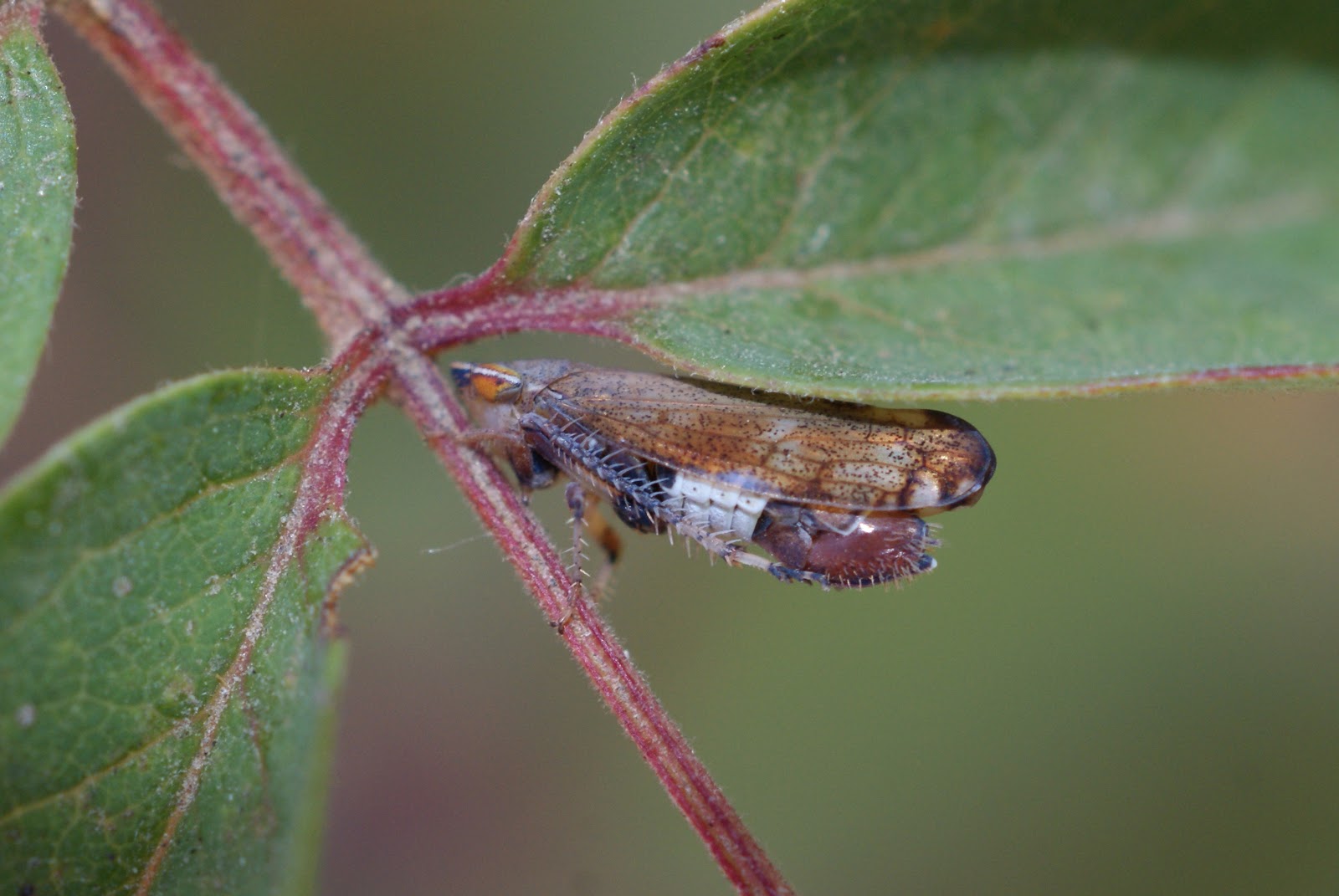
Some insects can blend into the background, but only if they pick the right spot.  For the numerous true bugs (Hemiptera) that spend nearly all their time sitting on plants and drinking sap, the best camouflage could be to look like a part of the plant.

A leafhopper nymph (possibly Xerophloea sp.) sitting at a node along a plant stem.
At first glance, I mistook the leafhopper above for a new bud.  Perhaps a potential predator would have been similarly deceived.  However, there was no chance of making the same mistake with this bug:

One of these thorns is not like the others.
The two-horned treehopper (Ceresa diceros) might pass for a thorn on some plants -- but not on this rose bush.  On the other hand, the horns (and the rest of the armor-like "helmet") might be enough to discourage many would-be predators.

The false thorn on this rose bush is a two-horned treehopper (Ceresa diceros).
Explore some more: The surreal treehoppers and The strange origin of the treehopper "helmet"

Monday, August 26, 2013

From a cradle to a grave

When the rose hip flies lay their eggs, they appear quite vulnerable.  The flies that I watched spent more than a minute with their ovipositors embedded in the rose hips.  If a predator was lurking nearby, it seems that the flies would have trouble escaping in time -- and, indeed, the rose hips are crawling with predators.

A jumping spider (probably an Eris species) sitting on a rose hip.
I can usually find jumping spiders on the rose plants and often on the rose hips themselves.  However, despite the apparently easy targets presented by the rose hip flies, I have not seen any being consumed by the jumping spiders.  Instead, I came across one of the jumping spiders with what I consider to be a much trickier prey item: another spider!

A cobweb spider (Enoplognatha ovata) being eaten by a jumping spider on a rose hip.

Friday, August 9, 2013

A cradle of roses

As the rose hips ripen here in Maine, they are acquiring both a pretty red blush and quite a few pockmarks.  What has been causing these small scars on the surfaces of the rose hips?

A ripening rose hip with several small, dark wounds.
In the past, I had often seen rose hip flies (Rhagoletis basiola) sitting on and nearby the rose hips.  These flies did not seem to be doing much, though, except sometimes rotating their wings in what may be a mating display.  However, over the last few days, I have caught a couple of the flies in the act --

A rose hip fly (Rhagoletis basiola) ovipositing into a rose hip.
 -- puncturing the rose hips with their ovipositors and laying their eggs inside.

Another rose hip fly (Rhagoletis basiola) ovipositing into a rose hip.
When I waited for one of the flies to finish laying and leave, I saw a fresh hole in the rose hip.  Checking back the next day, I found that the hole had scarred over to match the many other pockmarks on the rose hip.

Monday, July 8, 2013

A warm welcome

Last week, I returned to Washington after four months of travels.  Of all the many things there were to do after getting home, one task near the top of my list was to search the garden for crab spiders.  Before leaving Washington in March, I had found just one crab spider in the yard.  How many were there now?  It took just a couple of minutes for me to locate the first crab spider, and then in quick succession I found several more, including this one: 

A juvenile crab spider on a daisy.
After bringing the tally up to six crab spiders, it was time for me to retreat out of the ~95°F heat and to turn to more mundane tasks.  However, the next morning, I took advantage of my jetlag and was out in the garden very early, while it was still cool.  During this second and more thorough search, I found ten more crab spiders.

A female Misumena vatia crab spider ready for some prey.
A couple of these I found not on flowers, but on foliage.  These spiders were either in transit between flowers or had opted for less conventional hunting sites.

A juvenile crab spider sitting at the tip of a rose stem.

Thursday, February 14, 2013

My Valentine bee

Many millions of roses have been cut for Valentine's Day, but I much prefer my roses uncut -- and, of course, full of insects and spiders.  So, here is a bright red Valentine's rose for all my readers, complete with a metallic green bee!

A metallic green bee (Agapostemon sp.) in a red rose.

Monday, November 12, 2012

In the pink

Leafhoppers are a common sight in the garden, yet I rarely consider writing about them.  One reason is that I never see them do very much.  They feed on plant sap and, consequently, spend most of their time sitting still on plants.

A privet leafhopper (Fieberiella florii) on a rose bush.
The exception is when they are provoked (for example, by my camera getting too close).  Then, they can jump a very impressive distance for an insect called only a "hopper".  However, this interesting ability is difficult to capture with the camera.

A froghopper on a lamb's ear leaf shortly before it escaped the camera.
Another reason to overlook the garden hoppers is their dull coloration.  Until last week, all the hoppers I had found in my garden were some sort of brown, such as the ones pictured above.  Thus, I was very surprised to find a bright pink hopper when I was clearing away fallen leaves.

A pink leafhopper that I uncovered under some leaf litter.
Some leafhoppers are pink as adults, but the one pictured above doesn't match the descriptions I have found.  Another possibility is that it had just gone through its final molt and had not yet darkened to its adult color.

Friday, October 5, 2012

Home sweet home

Inside a leaf, an insect can gain food and shelter simultaneously.  The challenge is that leaves are nearly flat.  It seems like it should be very difficult for insects to live inside them -- at least not without making a gall.  Yet, the larvae of numerous species of moths, flies and other insects have overcome this challenge.

These larvae are known as 'leaf miners' and they leave distinctive marks on the leaves they inhabit.  Some leaf miners take long, winding paths through their leaves.  The resulting 'serpentine' trails are often filled with the frass (droppings) of the larvae, which turns the trails black behind the leaf miners.  To me, this seems like a big drawback of living inside your food.

The trail left in a rose leaf by a leaf miner, possibly a larva of the moth Stigmella rosaefoliella.
Other leaf miners consume large patches of leaves, creating opaque 'windows'.  Sometimes, as in the picture below, the leaf miner can be seen through the window.

A leaf miner is visible through a 'window' in a common morning glory (Ipomoea purpurea) leaf.
To get a better look at the leaf miner pictured above, I flipped the leaf over.  I found that this morning-glory leaf miner (Bedellia somnulentella) was keeping its feeding area clean by expelling its frass through a hole in the leaf surface.  It would seem that, in the case of leaf miners, outdoor plumbing is the significant innovation.

A morning-glory leaf miner (Bedellia somnulentella) in a common morning glory (Ipomoea purpurea) leaf.

Tuesday, October 2, 2012

New arrivals

This weekend, I went in search of the source of the woolly alder aphids (Paraprociphilus tessellatus) that have been swarming my neighborhood.  When on tree branches, these aphids form white, woolly masses that should be easy to spot.  I don't have their host plants (alders and maples) in my yard, but I thought some of those trees must be nearby.  I checked the alders in a nearby park, but their branches appeared clean.  If it hadn't been windy, I might have gotten a clue about where to look from the density of the aphid cloud.  As it was, I didn't see any aphids flying at all.

Wherever they had come from, the woolly alder aphids were still all over my backyard.  Some were sitting on foliage, presumably sheltering from the wind; quite a few others had been caught in spider webs.  While looking for the woolly aphids, I also discovered several more typical aphids -- ones that might be content with the plant selection in my yard.

A winged aphid on a morning glory leaf.
A winged aphid surrounded by her juvenile offspring on a rose leaf.
For much of the year, aphids reproduce asexually.  Without mating, the females can give birth to many live daughters, which are soon ready to produce their own daughters.  Therefore, a single aphid can quickly generate a large population. 

However, there is little chance that these new aphids will pose a threat to the plants in my backyard.  Starting tomorrow night, we are expected to have a series of hard freezes.  Even if the aphids survive the frost, there won't be much more damage that can be done to the plants this fall.

Wednesday, July 25, 2012

A galling development

The rose bushes in our garden appear to be going through a difficult age.  Each time I walk by, I notice more large red "pimples" swelling up from their leaves.

Wasp galls on rose leaves.
To my surprise, when I poked one of these "pimples", it popped right off the leaf.  Curious to know what, if anything, was inside the gall, I dissected it.

Wasp larva inside a rose gall.
Inside, I found the culprit.  A wasp larva (probably Diplolepis sp.) was growing inside the gall, feeding on the soft tissue of the walls.

Saturday, July 14, 2012

Beetle mania

Despite their appealing colors and smells, ornamental roses do not reward flower visitors with much nectar.  This is not a problem for the invasive Japanese beetle (Popillia japonica), which will voraciously consume the flower itself.  The presence of a beetle on a flower quickly attracts more beetles, leading to a feeding frenzy.

Japanese beetles (Popillia japonica) on a rose flower.
In addition to devouring flower petals, the beetles will skeletonize leaves by eating all the tissue between the veins.  The beetles will feed on a wide variety of plants, and since they do not have many natural enemies in North America, they can number in the thousands within a small area and do devastating damage.


Wednesday, June 27, 2012

Be careful when you stop to smell the roses

The wild roses are in full bloom and they are my first stop on each trip to the backyard.  As soon as I step out the door, I am greeted by their delicate and inviting fragrance.  However, I approach them hesitantly, scanning each blossom from a distance before stealthily drawing closer.  Although I have been caught by the thorns a few times in the past, my caution stems from a different source.

Many of the flowers harbor hungry predators waiting to pounce on their next meal.

A female crab spider (Misumena vatia) waits ready to grab its next meal with its raptorial forelimbs.
Of course, I am in no danger of ending up on the menu.  The predators are crab spiders; for them, even bumble bees are usually too large to handle.  The reason that I must move carefully is to avoid startling the spiders.  If I move too quickly or let my shadow fall over them, they may go into hiding underneath their flowers.

Instead of building webs, these spiders ambush their prey.  They have long forelimbs that they hold outstretched (resembling a crab's claws) until some unwary victim comes within reach.  Flowers are ideal hunting sites, since not only do they attract many insects, but also the insects are preoccupied with gathering food and may not notice the spider until it is too late.

As long as they are not disturbed, female crab spiders are unlikely to move much farther than to a neighboring flower.  This makes it possible to locate the same spider day after day.  But why take the trouble to look for something that sits nearly motionless for hours at a time?  By checking on a crab spider briefly each day, you can follow its progress as it tries out new hunting sites and strategies, changes color to match its current flower, consumes ever larger and more impressive prey, constructs a nest and guards its eggs.  If you are lucky (or set up a video camera), you may even chance upon the rare moment in which the spider moves with astonishing speed to grapple with its prey.

Therefore, even though these spiders will not harm you, you should be careful when you stop to smell the roses.

A male Misumena vatia eats a very small fly.