Showing posts with label dragonfly. Show all posts

Wednesday, September 24, 2014

Flying into the fangs of danger

Damselflies are nimble predators of other insects, but even predators can become the hunted if they are not careful.  The damselfly pictured below appears to be suspended in flight...

A slender spreadwing damselfly (Lestes rectangularis) hanging in mid-air?
...because it is suspended -- from the spider web it had just flown into.  As usually happens when something becomes tangled in a spider's web, the spider quickly approached to secure its prey.

A spider approaches the damselfly caught in its web.
The damselfly was not about to be taken without a struggle, however.

The damselfly attempts to evade the spider.
By beating its large wings, the damselfly was able to force itself free from the web just in time.  A similar encounter must have occurred between the dragonfly and spider pictured below, but with a very different ending.  Apparently, having strong wings is not always enough to escape becoming a meal for a spider.

A giant lichen spider (Araneus bicentenarius) with a dragonfly in its web.

Friday, February 14, 2014

The king of hearts

Happy Valentine's Day!  To celebrate, here is a photograph of one of the most remarkable -- and occasion-appropriate -- insects that I have seen recently: a dragonfly covered in red hearts.

A male calico pennant (Celithemis elisa).
If you look closely, you can see two hearts inside the large dark splotches on the dragonfly's hindwings in addition to the four hearts (and one broken heart) on the dragonfly's abdomen.  Female calico pennants have a similar pattern, but with yellow markings instead of red ones.  Therefore, the females bear a close resemblance to their close relative (and another holiday dragonfly), the Halloween pennant (Celithemis eponina).

Friday, November 22, 2013

Gotta find them all!

The park across the street has a sign advertising some of the organisms that are likely to be found by visitors to the park. (Note that the sign does not include the organisms most likely to find visitors to the park, namely the mosquitoes and chiggers).

Which one of these doesn't quite belong?
I have already made considerable progress in documenting each of the organisms on the sign (and have either seen or heard all but one of them).  Here is a quick guide to each organism, starting from the top left of the sign:

Ladybug: I have found at least three species of ladybugs (a.k.a. lady beetles) in the park.  However, since the drawing was specifically of a seven-spotted lady beetle, I will show that species too.  This species was an interesting choice for the sign, given that it is not native to North America.

Two seven-spotted lady beetles (Coccinella septempunctata).
Dragonfly: I was absorbed in watching a bee (notably omitted from the sign) when I was startled by the sound of the dragonflies pictured below.  They were making a violent clattering as they beat their wings against the vegetation in their struggle.

A male (left) attempting to mate with a female (right) variegated meadowhawk (Sympetrum corruptum).
Turtle: I didn't even have to cross the street to find a turtle.  The one pictured below was on the grass along the sidewalk outside my apartment.

Probably a red-eared slider (Trachemys scripta elegans), but it was hiding its "ears" along with much of the rest of its head.
Squirrel: You may have noticed that I skipped over the acorn.  I don't remember seeing any in the park, but they may have been there (I was not looking specifically for them) or they may have all been hidden by the many squirrels, most of which appear quite well fed.

A fox squirrel (Sciurus niger), but still no acorn.
To be continued...

Thursday, October 31, 2013

Happy Halloween!

Is your Halloween costume ready?  The females of the dragonfly species known as the "Halloween penant" stay "dressed" in orange and black their entire adult lives.  Yet, they are only likely to be seen on Halloween in the southernmost (and warmest) part of their range -- Florida.

A female Halloween pennant (Celithemis eponina).

Thursday, December 27, 2012

The dragonfly's lair

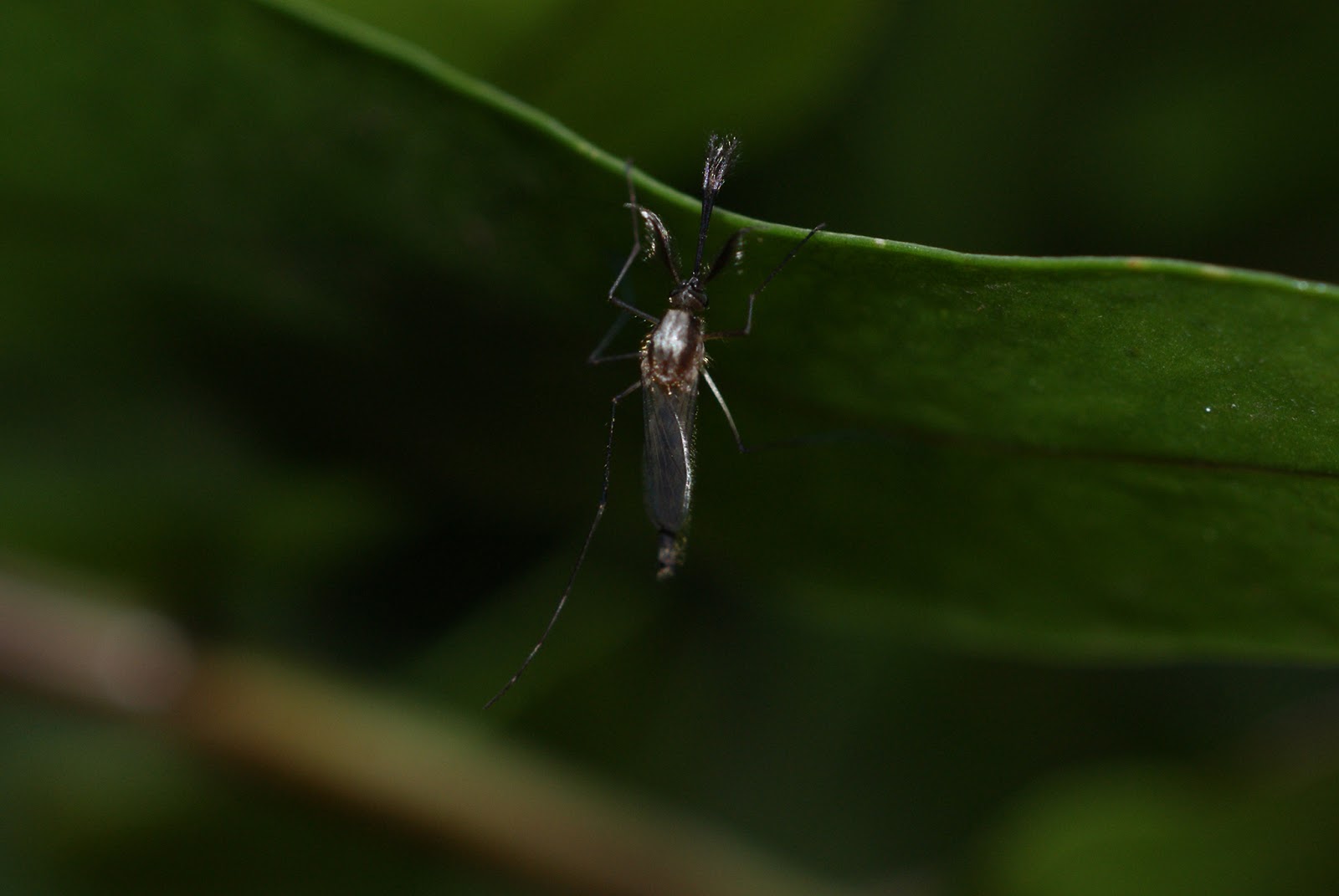
The pleasant winter climate in Florida comes with a catch -- mosquitoes are out and they are looking for blood.  Furthermore, they are frustratingly good at finding and extracting my blood.  Thus, it wasn't long before I received several painful and itchy reminders of the need to take precautions (such as wearing long sleeves and pants) before going out into the garden for any length of time.  Another component of my campaign against mosquito bites is to eliminate female mosquitoes on sight.  Consequently, I only get photographs of the males, which are harder to find but do not pose an immediate threat.

A male mosquito resting on a leaf (note the bushy antennae that distinguish males).
My campaign is supported by at least one resident mosquito hunter: a dragonfly.  In the mornings and evenings, I catch only brief glimpses of the dragonfly as it patrols the garden.  However, in the middle of the day I can pretty reliably find the twilight darner (Gynacantha nervosa) roosting in a sheltered part of the garden.

A twilight darner (Gynacantha nervosa) spending its day hanging from a palm frond.