Showing posts with label flower. Show all posts

Wednesday, May 6, 2015

More than an itch, part one

For an insect, a bug bite is likely to be a life threatening affliction.  Although most of the creatures we think of as delivering "bug bites" are not true bugs (i.e., they do not belong to the order Hemiptera), there are several groups of predatory true bugs.  Given their name, it should come as no surprise that the assassin bugs are a prime example.

An adult milkweed assassin bug (Zelus longipes).
I frequently find assassin bugs on plant foliage, waiting in ambush.  More rarely, I see one that has had recent success in capturing a smaller insect to consume through its sharp, straw-like mouthparts.

A milkweed assassin bug nymph with its prey.
Flowers are also good locations to ambush insects, so when I started spotting milkweed assassin bugs on flowers, I initially assumed that they were waiting to catch unwary flower visitors.  However, the orange and black bugs were so conspicuous against the white petals that any insect landing on those flowers would have to be extremely unwary.  Then, I noticed that some of the flowers hosted not just one, but two assassin bugs -- making the chances of a successful ambush even slimmer.  Only once I was able to inspect the photographs did it become apparent that the assassin bugs had a different motivation for coming to the flowers.

The milkweed assassin bugs also seem to feed on flowers.
Instead of hunting insects attracted to the flowers' nectar, the assassin bugs appeared to be drinking the nectar themselves!

Friday, March 13, 2015

The caterpillars eat their match, part three

Compared to the orange-barred sulphur butterflies, adult geometrid moths do not appear very active (at least not during the day)...

A pale beauty moth (Campaea perlata).
...and most of them are not very bright or flashy.

A large lace-border moth (Scopula limboundata).
However, geometrid caterpillars can be just as impressive as orange-barred sulfur caterpillars when it comes to blending in with the flowers that they eat.

A purple geometrid caterpillar on purple flowers.
In addition, at least some geometrid caterpillars have the same ability to change their color in order to match their background.  

A pink geometrid caterpillar on a pink rose blossom.
Although many geometrid species feed on other parts of plants (and mimic those instead), there are well over a thousand species of geometrid moths in North America -- including plenty of ones with colorful, flower-eating caterpillars.  See a few more of them here: Geometrid larvae on flowers

Friday, January 16, 2015

The caterpillars eat their match, part two

When they eat the leaves of their host plants, the caterpillars of the orange-barred sulphur butterfly are green.  However, the one that I found was not eating the leaves, nor was it green.

An orange-barred sulphur (Phoebis philea) caterpillar on a Christmas cassia (Senna bicapsularis) flower.  The flower to the right had already been reduced to almost nothing, presumably by the same caterpillar.
Instead, the caterpillar was the same bright yellow as the flower on which it rested -- and which it would soon eat.  The only thing that prevented the caterpillar from blending in with the flower completely was its pattern of black stripes and spikes.

A few minutes later, the flower's style had already been consumed by the caterpillar.

Monday, December 22, 2014

The host with the most, part one

The bright, multicolored flowers of lantanas attract many insects to feed on the nectar they dispense.

A gulf fritillary (Agraulis vanillae) visiting lantana flowers.
However, a number of other insects specialize on extracting nutrients from lantanas in other, more destructive ways.  Recently, I observed many lantana leaves that had been hollowed out, particularly along and around the veins.

A mined lantana leaf.
Although I did not see any of the leaf miners themselves, the pattern of damage was characteristic of the herringbone leaf-mining fly.

More lantana leaves mined by the larvae of the herringbone leaf-mining fly (Ophiomyia camarae)
Meanwhile, other lantanas were suffering from an even stranger affliction -- they had thick growths of miniature stems and leaves where they should have had flowers and fruits.

Lantana flower gall mites (Aceria lantanae) made this plant produce tiny stems and leaves in place of flowers.
In this case, bud mites were the culprits.  The mites had manipulated the plants into switching from producing flowers to growing more vegetative tissue, which had developed into galls enclosing the mites.

Monday, September 22, 2014

The early bee and the flower, continued

Though a few bees collected nectar from the peony buds, the flowers had much more to offer once they were fully open.  In addition to nectar, the flowers produced large quantities of pollen, which was a big attraction to visitors such as the leafcutter bee (Megachile sp.) pictured below.  Unlike bumble bees and honey bees, which pack pollen onto their hind legs, this leafcutter bee is collecting pollen on the underside of its abdomen.


Pollen was not the only thing waiting inside the flowers, however.  One of the peonies contained an unpleasant surprise that threatened to make any visiting bee permanently late.

A crab spider (Misumena vatia) ready to ambush visitors to the peony.

Wednesday, September 17, 2014

The early bee and the flower

When is it too early for a bee to visit a flower?  You might guess that bees would not be interested in visiting a flower before it has opened.  However, if the flower in question were a peony, you would be wrong.

A two-spotted bumble bee (Bombus bimaculatus) visiting a peony bud.
Even as buds, peony flowers produce nectar from glands on the sepals (the modified leaves surrounding the petals).  In addition to opportunistic bees, this extrafloral nectar is likely to attract aggressive ants that would attack anything attempting to eat the flower itself.

Friday, July 4, 2014

Happy Fourth (Crab Spider)!

Happy Fourth of July!  To celebrate the date, here is a picture with four crab spiders, including one happy spider with a fly.

Can you find all four crab spiders?
In case you had any trouble spotting all the spiders, here is the picture again, with the spider locations marked...

Three female and one male Misumena vatia crab spiders.
 ... and here is a closeup of the happy spider with her large meal.

The most successful of the four spiders, eating a fly.

Friday, May 30, 2014

A caterpillar in the bonnet

The bluebonnets attracted many more visitors than just bees this spring.  Among these other visitors were caterpillars – which came to feed on, rather than from, the flowers.

A caterpillar feeding on the buds of a Texas lupine (Lupinus texensis).
However, the flowers were not the most enticing part of the bluebonnets for herbivores.  Soon after the seeds pods began maturing, they started to become riddled with holes.  Meanwhile, the seeds that should have been developing inside were damaged or even completely missing.

Texas lupine seed pods after a seed predator attack.
The first insect that I found in the vicinity of the holes was a lady beetle. 

A seven-spotted lady beetle (Coccinella septempunctata) by a freshly chewed hole in a Texas lupine seed pod.
Yet, nearly all lady beetles, including the one pictured here, are primarily predators of other insects, not of seeds.  Therefore, it seemed unlikely that the lady beetle was the culprit.  Then, what was making all the holes?  To be continued…

Wednesday, May 21, 2014

Where the wild genes are

This spring, I taught a course on Animal Behavior.  Consequently, most of my enthusiasm for sharing the intricacies of the interactions among animals (and other organisms) was channeled towards the class rather than the blog.  During the course, I was able to learn many new things myself thanks to the hard work of my students.  Therefore, I encouraged the students to share their writing assignments on their class blog, "Where the Wild Genes Are".  Their posts on their own natural history observations, their analyses of the communication of science, and their contributions to Wikipedia articles will continue to be published every couple of days for the next few weeks.  I encourage you to follow their blog and learn about a wide variety of animals, behaviors, and concepts in behavioral ecology.

A monarch butterfly (Danaus plexippus) feeding on a crimson clover (Trifolium incarnatum).
Natural Current Events should also be getting back to a more regular schedule in the near future.   Although I did less posting this semester, teaching didn't mean that I stopped photographing.  If you want to see more pictures of Houston spring flowers, you can find a selection in the album here.

Friday, April 18, 2014

A bee in the bonnet

For the past couple of weeks, most of the open areas around my apartment have been carpeted (somewhat treacherously) with the Texas state flower -- the bluebonnet.

A field of Texas bluebonnets (Lupinus texensis) and a few other flowers too.
Although the bluebonnets themselves are innocuous, they have been attracting swarms of both honey bees and photo-op seekers.  While watching the former and trying to ignore the latter, I noticed that the bluebonnets are remarkable for more than just their vibrant color.

A honey bee (Apis mellifera) approaches a bluebonnet.
Each flower is blue with either a white or a purplish inner spot; however, the color of the spot is not random.  Only the youngest flowers, those at the top of the spike, have a white center.  As the flowers age, their spots turn purple, similar to how the markings on horse chestnut flowers change from yellow to pink (and likely for the same reason). 

A honey bee collecting nectar.
The structure of the bluebonnets is also impressive.  The actual reproductive parts are all hidden away inside the flowers, so how does pollen get picked up and deposited?  Unlike the bees that I have seen squeezing inside some other lupine flowers, a honey bee visiting a bluebonnet just lands on top of the flower.

When the honey bee lands, the flower opens, exposing the stigma and anthers.
The weight of the bee then pushes the flower open.  In the process, pollen from the flower's anthers is rubbed onto the bee and pollen from the bee may get stuck to the flower's stigma.  The flower stays open for a moment after the bee leaves, then snaps back into place until the next visitor arrives.

Friday, April 4, 2014

The lion's share of the aphid

A few weeks ago, while I was on a trip to Arizona, I took a walk in the desert.  (I did not make much progress as far as walking was concerned, though.)  There were many flowers blooming along the sides of the trail, so I zigzagged  from one flower to the next, checking for crab spiders or any other visitors (but really hoping for crab spiders). 

Brittlebush (Encelia farinosa) flowers and one of the several crab spiders that I found.
It was not long before my diligence was rewarded by my discovery of a very small crab spider.  After that, I checked each flower even more intensely and in the end found several small crab spiders, some with even smaller prey. 

A juvenile crap spider (Mecaphesa sp.) eating what looks like a thrips.
For example, the spider above is eating a tiny insect that appears to be a thrips.  Meanwhile, the remains of another crab spider's meal can be seen in the bottom left corner of the picture below (it is probably a tiny fly or bee).

This crab spider had already finished its meal (if you look closely, you can see what was left of it).
In my search for the spiders, I also encountered quite a few other visitors to the flowers, including another successful predator.  This predator was a lacewing larva that I caught in the act of living up to its name 'aphid lion'.

A lacewing larva, a.k.a. an aphid lion, with a captured aphid.

Monday, December 2, 2013

Behind closed petals

Hibiscus flowers are stunning while they last, but that is not for very long.  After just a few hours, or at most a couple of days, the petals shrivel up and the flowers drop to the ground. 

A blooming Texas star, a.k.a. scarlet rose mallow (Hibiscus coccineus).
Once the flowers wilt, they are unlikely to be pollinated or to transfer any more of their own pollen.  Yet, they may still have some nectar left inside.  Though the conventional route to the nectar is closed off, the nectar is not out of the reach of all visitors.

A carpenter bee (Xylocopa sp.) chewing through a closed hibiscus flower.
Large carpenter bees, such as the one shown in the pictures above and below, can chew through the expired flowers to reach any remaining nectar.

The carpenter bee starts to work on another flower.
Although this behavior is technically nectar robbing, the salvaging of left-over nectar by carpenter bees should not have any cost for the plant -- as long as the bees do not damage the flowers' ovaries in the process.

Friday, November 15, 2013

Looking for a new backyard

One of the challenges of moving to an apartment was that I would no longer have my own backyard.  Although I could observe the animals and plants in the apartment complex's landscaped areas, it might cause some misunderstandings if I started photographing and videotaping directly outside the ground floor residents' patio doors!  After some thought, I came to the conclusion that if I couldn't have my own backyard, I would find something even better -- and now my new "backyard" (just across the street) is a park complete with woods, meadows, a bayou, and a chain of ponds. 

A view of part of my new "backyard".
When first exploring this new backyard, I was quickly tempted off the trail and into the tall grass to chase a butterfly that turned out to be quite adept at eluding me.

A common buckeye (Junonia coenia) butterfly perched on grass.
Once off the trail, I found that the meadow, which looked quite plain from a distance, was in fact full of wildflowers...

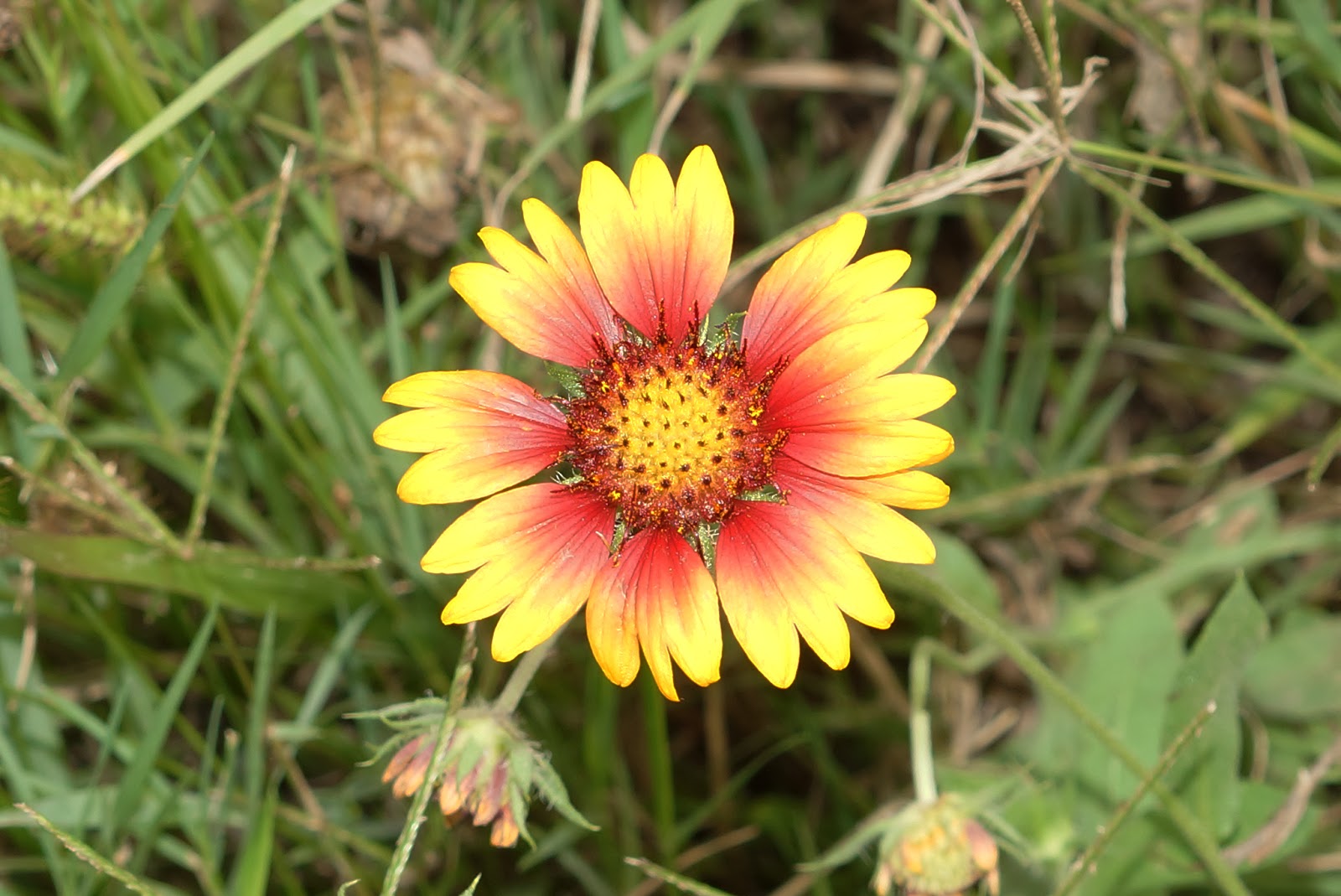
A blanket flower (Gaillardia sp.).
... and insects feeding at those flowers...

A skipper (Hesperiidae) visiting a flower.
... and also a surprising number of insects and mites that preferred to feed on me.  Therefore, in subsequent visits to the park, I made a slight adjustment to my wardrobe.

My new boots are not just for the rain!

Monday, November 4, 2013

Don't try this at home

In the summer, when it is warm and the flowers are plentiful, the vast majority of bumble bees out and about are female workers.  Instead of reproducing themselves, these workers collect nectar and pollen to feed to their mother (the queen) and their many younger siblings.  However, the workers are not all completely sterile.  After the queen dies towards the end of the season, some of the workers may begin laying eggs of their own.  Even though these eggs are unfertilized (since the workers never mated), they are still viable -- and they will all develop into males.

A male orange-belted bumble bee (Bombus ternarius) visiting a flower.
In bumble bees, as well as other Hymenoptera, the females are diploid (having two sets of chromosomes and developing from fertilized eggs) and the males are haploid (having only one set of chromosomes and developing from unfertilized eggs).  A consequence is that as bumble bee colonies begin to decline in the fall, more and more of the bumble bees visible on flowers will be males.

A male common eastern bumble bee (Bombus impatiens) visiting a cosmos inflorescence.
Male bumble bees differ from females in the number of their antennal and abdominal segments, the structure of their hind legs, and, in some species, the size of their eyes and the length and color of their hairs (especially on the head).  For example, notice the yellow fuzz on the face of the male bee below.  In the females of this species, the hairs on the face are black.

A very fuzzy male Bombus ternarius resting on a rock.
An important, and potentially less subtle, difference between male and female bumble bees is that only the females sting.  Bee stingers are modified ovipositors, which bees' ancestors used to lay eggs.  Since only the females had ovipositors, only female bees now have stingers.  Not only are male bumble bees unable to sting, they are also quite docile; many of the male bumble bees I found would tolerate being petted gently without flying away.

The bee was very fuzzy indeed!
Please note that I do not recommend trying this yourself (unless you have also worked extensively with bumble bees and are confident that (a) you can correctly identify the males and (b) you are not allergic to bumble bee stings).  Although less common in the fall, female bumble bees are still present and they may sting -- repeatedly -- with little provocation.

A male (above) and much larger female (below) Bombus impatiens.
Explore some more: Bumble bee identification and see more pictures of male bumble bees at the Natural Current Events Facebook Page.

Monday, October 7, 2013

More than a pain in the neck, continued

After noticing the pattern in how candy stripe spiders tackle their prey, I decided to look back at my many pictures of crab spiders for comparison.  As I had thought, the crab spiders also frequently bit their prey just behind the head.

A female Misumena vatia crab spider eating a tricolored bumble bee (Bombus ternarius) in 2012.
The crab spiders took a different approach, however, when their prey was a hover fly (Syrphidae). 

A juvenile crab spider eating a hover fly (Syrphidae) in 2012.
In these cases, as illustrated in the pictures above and below, the crab spider bit right into its victim's abdomen.

Another crab spider eating a hover fly, this time on a snapdragon.
In addition to having a soft abdomen, hover flies are relatively easy for crab spiders to catch.  One way for hover flies to compensate for their vulnerability is to spend more time inspecting landing sites for potential danger; indeed, hover flies can often be seen seemingly suspended in the air above flowers before touching down to feed or darting quickly away.

Two hover flies inspecting a flower before landing.