Showing posts with label bug. Show all posts

Monday, June 22, 2015

More than an itch, part five

Near the leaf-footed bug nymphs on the lantana were a couple of my favorite bug nymphs.  As adults, they look like typical bugs, but as nymphs they look remarkably like ants!

A broad-headed bug (Alydidae) nymph.
Nevertheless, they can be distinguished easily from real ants (such as the one pictured below) if you know where to look.  Despite mimicking an ant's appearance in many ways, these nymphs still have the long mouthparts characteristic of bugs.

A carpenter ant (Camponotus sp.).
The ant mimics also don't act much like ants.  When they are approached, they quickly run for cover and unlike some other bug nymphs, they aren't quick to return.

The ant mimic scurries away.

Friday, June 19, 2015

More than an itch, part four

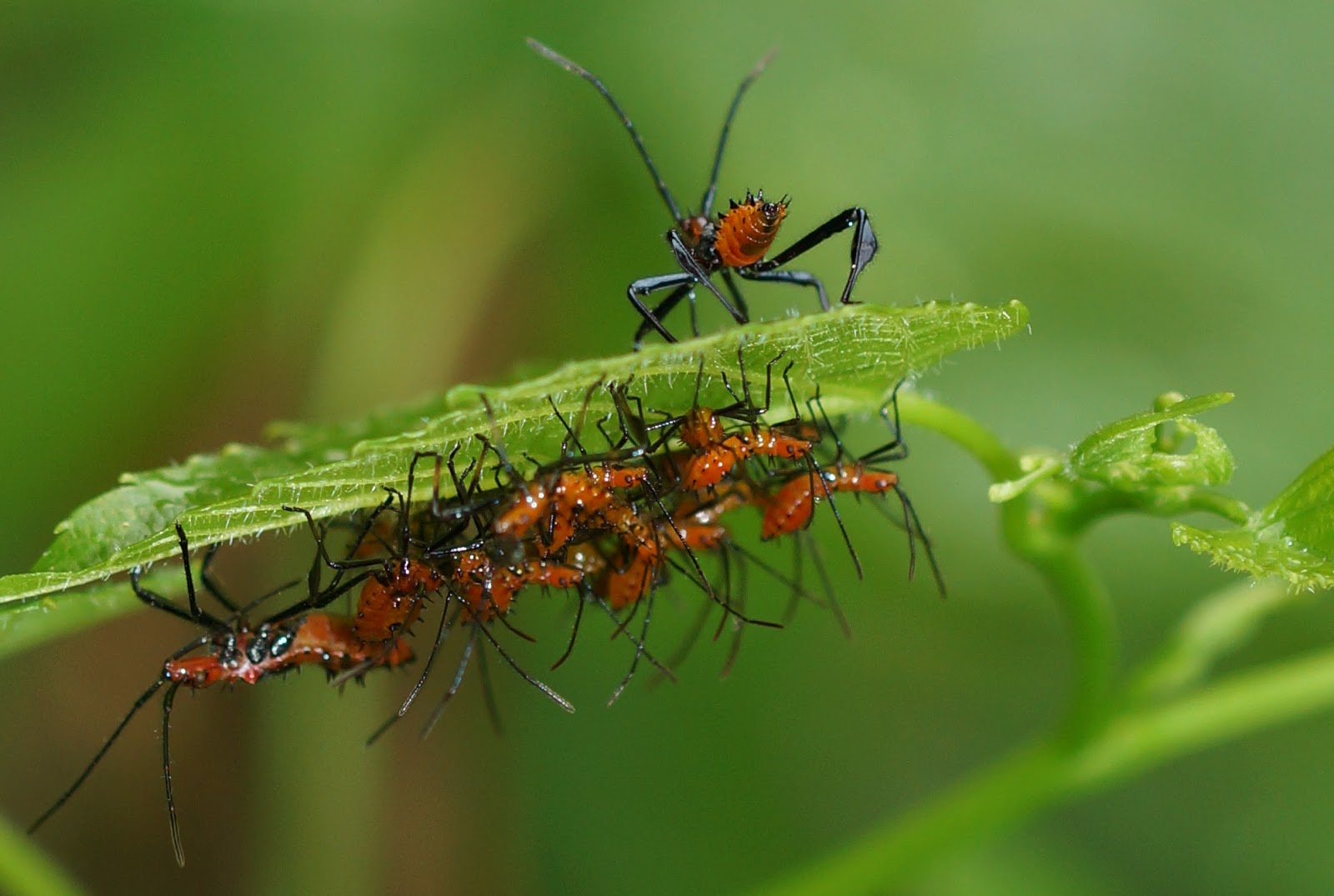
Like the bordered plant bug nymphs, leaf-footed bug nymphs are often found gathered in groups.  Therefore, the bug nymph pictured below appears to be unusually alone.

A leaf-footed bug nymph (Coreidae) on a lantana leaf.
However, looking from another angle reveals that the "lone" bug nymph is actually just the tip of the iceberg of bug nymphs!

Many more leaf-footed bug nymphs hanging underneath the leaf.
The large group of bug nymphs shared the limited space on the underside of the leaf peacefully.  However, another group feeding on unripe lantana berries nearby was not nearly so tranquil.


As I watched, an extended fight broke out between two of the nymphs.  They may have been competing over access to the berries.  Yet, there seemed to be plenty of berries available, which should have made a fight unnecessary.  An alternative explanation is that one of the nymphs may have tried to switch from eating berries to eating the other nymph, as some bug species are known to be cannibalistic.

Wednesday, June 17, 2015

More than an itch, part three

For most insects, tiny bug nymphs pose a negligible threat.  The threat is hardly increased when the nymphs are in a group (which they often are).  However, unlike the beetle being assailed by the stink bug, there are some potential victims that lack the mobility to attempt an escape.

A group of bright red bug nymphs (Largus sp.) feeding on a white object.
The group of bug nymphs pictured here had located one such immobile victim on a leaf.  In order to see what they had found, I blew air at them.  The nymphs quickly scattered across the leaf, revealing a while cocoon.

The bugs scatter revealing a cocoon.
Nearly as quickly, the bug nymphs began to return to the cocoon and to resume feeding on whatever had been developing inside.

The bugs begin to return.

Monday, June 1, 2015

More than an itch, part two

Compared to the assassin bugs, stink bugs (Pentatomidae) may seem to be unlikely predators. While most stink bugs do stick to feeding on plants, some supplement their diets with insects. Others are pure predators.

A leaf beetle (Ophraella sexvittata) being attacked by a predatory stink bug (Perillus sp.) on a goldenrod (Solidago sp.) leaf.
A few of the predatory stink bugs are even used to control agricultural pests. However, the stink bug shown here had trouble controlling just one small beetle.

The beetle struggles to get away.
The stink bug appeared to have pierced the beetle with its mouthparts, yet the beetle showed no sign of giving up.

The bug continues to pull away.
I did not see whether the beetle escaped in the end. Yet, what I saw when I came back several days later convinced me that neither the stink bug nor any other predators had been very successful in reducing the beetle population.

The goldenrod plants later that week.

Wednesday, May 6, 2015

More than an itch, part one

For an insect, a bug bite is likely to be a life threatening affliction.  Although most of the creatures we think of as delivering "bug bites" are not true bugs (i.e., they do not belong to the order Hemiptera), there are several groups of predatory true bugs.  Given their name, it should come as no surprise that the assassin bugs are a prime example.

An adult milkweed assassin bug (Zelus longipes).
I frequently find assassin bugs on plant foliage, waiting in ambush.  More rarely, I see one that has had recent success in capturing a smaller insect to consume through its sharp, straw-like mouthparts.

A milkweed assassin bug nymph with its prey.
Flowers are also good locations to ambush insects, so when I started spotting milkweed assassin bugs on flowers, I initially assumed that they were waiting to catch unwary flower visitors.  However, the orange and black bugs were so conspicuous against the white petals that any insect landing on those flowers would have to be extremely unwary.  Then, I noticed that some of the flowers hosted not just one, but two assassin bugs -- making the chances of a successful ambush even slimmer.  Only once I was able to inspect the photographs did it become apparent that the assassin bugs had a different motivation for coming to the flowers.

The milkweed assassin bugs also seem to feed on flowers.
Instead of hunting insects attracted to the flowers' nectar, the assassin bugs appeared to be drinking the nectar themselves!

Monday, December 8, 2014

When a tree falls in the forest, it makes a buzz

When I found the downed tree pictured below, I was glad that I hadn't been underneath when it fell.  Then, when I inspected the tree more closely, I was glad that I hadn't been anywhere nearby when it fell.

A recently fallen tree.
The signs left inside the tree suggested that it had not come down quietly -- due to the colony of honey bees that had been living inside.

A piece of wax comb left in the hollow inside the tree.
The tree had been dead long before it had fallen, and the hollow inside it made an attractive spot for honey bees to build their hive.  If the bee colony had not already abandoned the nest cavity before the tree came crashing down, there may have been several thousand very agitated bees emerging from the wreckage of the tree.  However, by the time I came by, the cavity had been mostly cleaned out by opportunists...

One of several bug nymphs foraging in the hollow.
...with only a few bug nymphs left roaming over the bits and pieces of the bees' nest.

A close-up of another bug nymph.

Monday, November 11, 2013

Assassins all around, part two

The lone assassin bug that I found in Maine did not seem to have many food options available as winter approached.  In contrast, back here in Houston, the thriving insect community is still supporting a large and diverse population of assassin bugs.  I've found these assassin bugs lurking in the park across the street...

A milkweed assassin bug (Zelus longipes), not on milkweed.


... poising to strike from the flowers along the road...

Another assassin bug on goldenrod (Solidago sp.).
... and even coming in through the hallway window at work.  Since I did not have my camera with me at the time, I captured this last assassin bug and brought it home for further observation.

A leafhopper assassin bug (Zelus renardii) that I caught and brought home.
Just like the nymph that I described previously, this related species of assassin bug keeps its front legs sticky, presumably to aid in capturing prey.  Having sticky legs does come with a significant drawback though, as I noted when I put this assassin bug into a container with some dirt.  Almost immediately, its legs were coated in the dirt.  When given a choice, however, the assassin bug appeared careful to avoid walking directly on dirt -- and by the next morning, it had managed to clean off all the debris.

Friday, November 8, 2013

Assassins all around, part one

In the yard in Maine, the most stunning transformation that occurred during the transition from summer to fall was of the burning bushes.  These small trees went from rather modest plants to the most ostentatious ones in the garden, with vividly pink leaves...

Fall foliage of the burning bush (Euonymus alatus).
... and multitudes of brilliantly red fruits.

Burning bush branches loaded with dehisced fruits.
 As I was admiring the burning bushes, one leaf with a bit more green on it stood out from the others.

A pale green assassin bug (Zelus luridus) nymph on the burning bush.
Hanging on to the leaf was an immature pale green assassin bug (Zelus luridus) waiting to grab prey with its sticky forelegs and then stab the prey with its sharp beak.

The assassin bug nymph raising its sticky forelegs in defense, or maybe in preparation for attack!
Though the assassin bug initially seemed disturbed by my attention, I kept seeing it on the same leaf over the next couple of days.  Then, the leaf fell from the tree and the assassin bug disappeared with it.

Wednesday, November 21, 2012

Coming in from the cold

When it is cold and rainy, it becomes more difficult to find insects and spiders outside -- but easier to find them inside.  Each day, I discover one or two new "guests" that have arrived in the house.  Although they are all uninvited, I have been letting most of them stay.  Many, such as the spider and ladybug pictured below, are predators that should help to keep the number of other "guests" low.

A spider that was roaming the floor.
A seven-spotted ladybug (Coccinella septempunctata) that has been patrolling my houseplants.
Others are simply too troublesome to handle, such as the several western conifer seed bugs that have gotten inside.  They won't cause any problems as long as they are left alone, but they may release an unpleasant smell if they are disturbed.

A western conifer seed bug (Leptoglossus occidentalis) climbing the blinds.

Friday, November 16, 2012

The better to see you with

With winter quickly approaching, prey must be getting scare.  Yet, I still find many predators roaming the garden.  In addition to numerous spiders and ladybugs, I recently found one predator that is uniquely endowed to seek out whatever prey remains: a big-eyed bug.

A big-eyed bug (Geocoris sp.) on a hollyhock leaf.
These small bugs use their disproportionately large eyes to locate their prey, which include even smaller insects, insect eggs, and mites.

Wednesday, October 31, 2012

Happy Halloween!

Soon, trick-or-treaters will start coming to the door for candy.  However, I've already had one visitor that seemed more interested in a different kind of treat: my pumpkin.

The bug that was sitting on my pumpkin.
Now for another treat, or maybe a trick --

A caterpillar that I found on a bush next to the highway.
-- or perhaps even a "costume" of sorts.  The "face" on this caterpillar is actually on its body and the top of its head (which is bent forward as it eats the leaf).

Tuesday, October 30, 2012

A late bloomer

After several frosts and a snow shower, winter does not feel very far away.  Nevertheless, there is one plant in the garden that has just started blooming.  With its leaves tinged red, it had appeared to be shutting down as the weather turned colder.  However, this little plant is now covered in bright purple and yellow inflorescences. 

Flowers of the late-blooming aster.
I have been curious whether anything will come to pollinate these aster flowers, since the cold and wet create considerable difficulties for flying insects.  During brief periods in which the sun has come out, I have checked the flowers for visitors.  However, some of the flowers still needed more time to dry off after the rain.

A water droplet trapped in the aster inflorescence.
Even when dry, the flowers haven't seemed very successful in attracting pollinators.  I only found one insect visiting the flowers, and it was a bug that may have been doing more harm than good for the plant.

A bug in the aster flower.

Monday, October 8, 2012

The decoy

After finding three praying mantises last week, I have been hoping to find one or more of them again.  Praying mantises will hide in order to ambush their prey; thus, I have been scanning plant stems more carefully than usual.  Although I haven't had any luck finding the praying mantises, I did manage to find another inconspicuous insect -- a western conifer seed bug (Leptoglossus occidentalis).

From the side, the western conifer seed bug (Leptoglossus occidentalis) can easily be overlooked.
It is more obvious when seen from above.
While I was watching the bug pictured above, I suddenly had the feeling that something had fallen into my hair.  I instinctively flicked the object with my hand.  Luckily, I didn't grab the mystery object -- since it turned out to be another western conifer seed bug.  Though these bugs don't bite, they can release a noxious odor, similar to that of a stink bug.

The bug was initially knocked to the ground, but it recovered quickly and took flight.  I followed it until it landed in a nearby pine tree, which is one of its host plants.

A western conifer seed bug (Leptoglossus occidentalis) on a pine tree.

Friday, September 14, 2012

The seed defenders

Many seed predators have converged upon the hollyhocks and are feasting on the seeds.  Nevertheless, things may not be as bad as they first appear for this new generation of hollyhocks -- for the seed predators have been attracting enemies of their own.  During my rounds through the garden, I have noticed that the hollyhock seed pods are also routinely patrolled by a number of predators.  The most common of these predators are wasps and ladybugs.

A European paper wasp (Polistes dominula) on a hollyhock seed pod.
A ladybird beetle (Coccinellidae) inside a hollyhock seed pod.
Although many of the hollyhock seed predators that I have seen are bugs, not all of the bugs on hollyhocks are necessarily there to eat seeds.  When I first saw the bug pictured below, I thought it was piercing through the pod to reach the seeds inside.

A bug eating a much smaller insect, speared on its mouthparts.
Upon close inspection, however, a very small insect is visible at the end of the bug's mouthparts.  In contrast, the bug pictured below was no longer a predator of any kind.  Instead, it had become the prey of a crab spider.

A crab spider (Mecaphesa sp.) eating a bug on a hollyhock seed pod.

Tuesday, September 11, 2012

Please stop bugging my plants

Just a few hollyhock flowers, at the very tops of the stalks, are still blooming.  Only occasionally does a bee come to visit one of these flowers.  This is a vast change from earlier in the summer, when the flowers were abuzz with a frenzy of pollinator activity.  Proof of this past pollinator attendance remains further down the stem, in the form of pods packed with seeds. 

A ring of hollyhock (Alcea rosea) seeds is visible within the seed pod.
The multitude of seeds has made me hopeful that next year we could have many more hollyhocks growing in the garden.  Unfortunately, hordes of insects have another plan for these seeds: dinner.

A stink bug (Pentatomidae) feeding on hollyhock (Alcea rosea) seeds.
Among the worst offenders are several species of true bugs.  These bugs sit on the outside of the seed pods and pierce both the outer wall and the seeds with their long, straw-like mouthparts.

A seed bug feeding on hollyhock (Alcea rosea) seeds.


Since the bugs are feeding on seeds before they have completed developing, I can't even harvest them to keep them safe.  I just hope that some seeds will survive this gauntlet of seed predation.

An immature bug feeding on hollyhock (Alcea rosea) seeds.