A dense group of fall webworms (Hyphantria cunea) inside a silk nest.
In order to construct and extend the sheets of silk, some of the caterpillars spend time exposed on the outside of the nest. There, they take advantage of their numbers to defend themselves in another way -- by making a coordinated, threatening display.
The synchronized action of the caterpillars is thought to discourage predators and parasites. Though the twitching sometimes appears to begin spontaneously, it can also be triggered when something approaches the caterpillars. For example, in the video above, the last bout of twitching appears to be in response to the arrival of a small fly or wasp on the other side of the nest (~1:44).
When feeding in a large group, caterpillars may be more noticeable to predators -- but they may also be better able to defend themselves. Groups of tent caterpillars and webworms can consist of hundreds of individuals, which makes them easily spotted (and probably smelled) even from a distance. To thwart their many enemies, these caterpillars surround themselves and their feeding zones with a protective netting of silk.
A nest of fall webworms (Hyphantria cunea) on a mulberry branch.
The caterpillars then proceed to devour nearly everything within their tightly woven nest. As they move along a branch, all that they leave behind are leaf skeletons wrapped in silk.
The larvae can completely skeletonize large leaves.
Meanwhile, any predators that locate the caterpillars are likely to depart without obtaining a meal. Watch a wasp get foiled by the silk enclosure in the video below:
The water covering the ground gradually drained and evaporated away, slowly enough that the swarms of tadpoles had a chance to make the transition to a more terrestrial lifestyle. Many of them still had a lot of growing left to do, though.
A toadling in the leaf litter.
As I walked through the forest, I kept sending waves of tiny toads hopping for cover.
A closer view of the toadling.
They were so small and well camouflaged in the leaf litter that they would easily have been overlooked if they had just remained still.
Another toadling blending in with the leaf litter.
However, the toadlings on the path through the woods faced a different problem. They could not hop quite enough. The raised edge of the trail proved too high an obstacle for their small legs, trapping them until they found some place to squeeze through.
Here in Houston we've been having a bit of rain recently (to put it mildly). As a result, the woodland near my apartment became more of a wetland. Not only did puddles appear all around, but so did plenty of frogs and toads ready to take advantage of them. There isn't much action in the video below, but you can hear the calls of several eastern narrow-mouthed toads (Gastrophryne carolinensis) competing to attract mates.
Many frogs and toads had apparently already been successful in attracting mates, as the puddles were swarming with tadpoles of various shapes and sizes.
The trail through the woodland -- turned into a tadpole spawning ground.
The puddles were also excellent breeding grounds for mosquitoes, so I hoped that the tadpoles were feasting on all the mosquito larvae.
One of the larger tadpoles.
Meanwhile, some other animals proved to be better at coping with the new landscape than might have been expected.
A spider walks across one of the plethoric puddles.
Near the leaf-footed bug nymphs on the lantana were a couple of my favorite bug nymphs. As adults, they look like typical bugs, but as nymphs they look remarkably like ants!
A broad-headed bug (Alydidae) nymph.
Nevertheless, they can be distinguished easily from real ants (such as the one pictured below) if you know where to look. Despite mimicking an ant's appearance in many ways, these nymphs still have the long mouthparts characteristic of bugs.
A carpenter ant (Camponotus sp.).
The ant mimics also don't act much like ants. When they are approached, they quickly run for cover and unlike some other bug nymphs, they aren't quick to return.
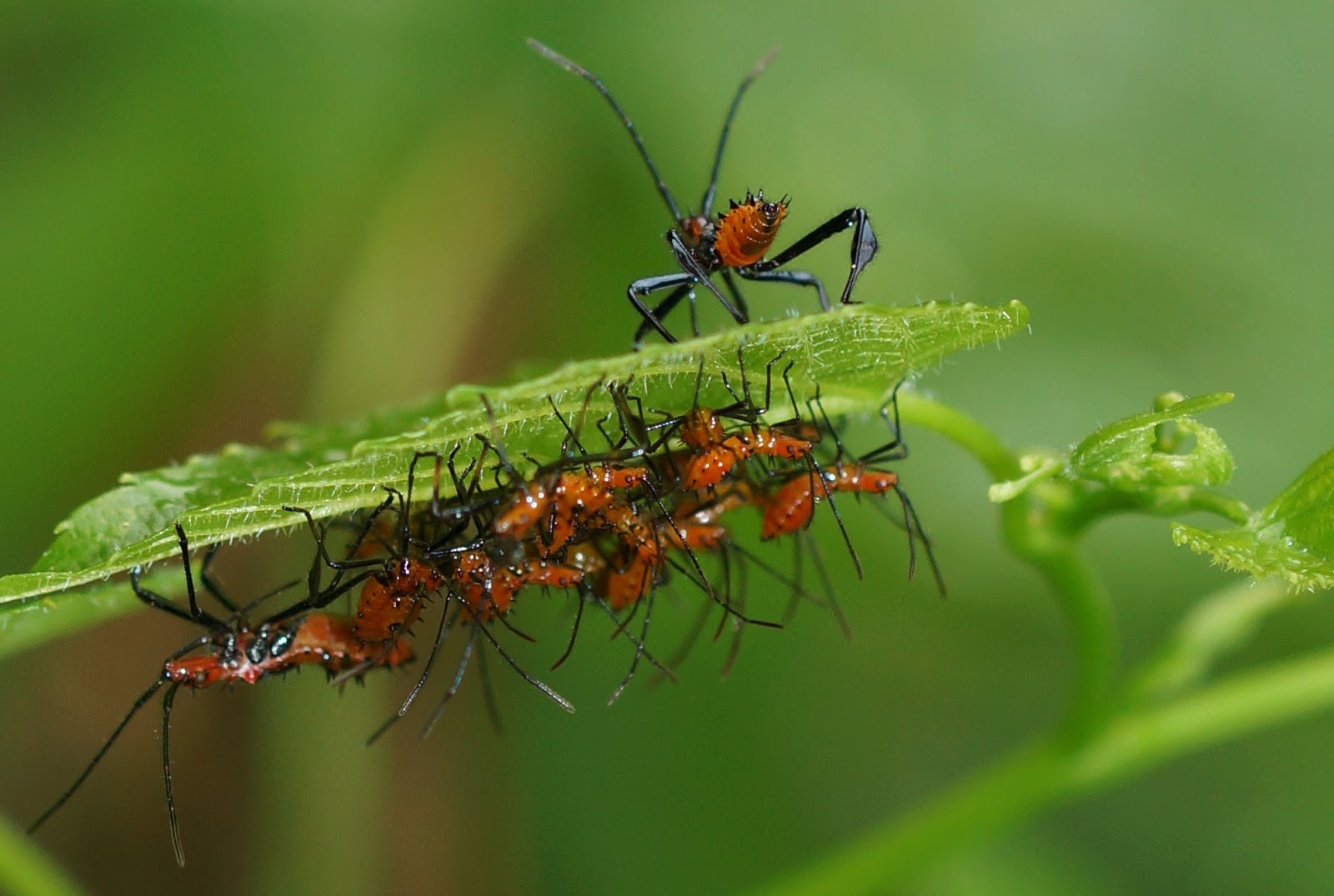
Like the bordered plant bug nymphs, leaf-footed bug nymphs are often found gathered in groups. Therefore, the bug nymph pictured below appears to be unusually alone.
A leaf-footed bug nymph (Coreidae) on a lantana leaf.
However, looking from another angle reveals that the "lone" bug nymph is actually just the tip of the iceberg of bug nymphs!
Many more leaf-footed bug nymphs hanging underneath the leaf.
The large group of bug nymphs shared the limited space on the underside of the leaf peacefully. However, another group feeding on unripe lantana berries nearby was not nearly so tranquil.
As I watched, an extended fight broke out between two of the nymphs. They may have been competing over access to the berries. Yet, there seemed to be plenty of berries available, which should have made a fight unnecessary. An alternative explanation is that one of the nymphs may have tried to switch from eating berries to eating the other nymph, as some bug species are known to be cannibalistic.
Compared to the assassin bugs, stink bugs (Pentatomidae) may seem to be unlikely predators. While most stink bugs do stick to feeding on plants, some supplement their diets with insects. Others are pure predators.
A leaf beetle (Ophraella sexvittata) being attacked by a predatory stink bug (Perillus sp.) on a goldenrod (Solidago sp.) leaf.
A few of the predatory stink bugs are even used to control agricultural pests. However, the stink bug shown here had trouble controlling just one small beetle.
The beetle struggles to get away.
The stink bug appeared to have pierced the beetle with its mouthparts, yet the beetle showed no sign of giving up.
The bug continues to pull away.
I did not see whether the beetle escaped in the end. Yet, what I saw when I came back several days later convinced me that neither the stink bug nor any other predators had been very successful in reducing the beetle population.
For an insect, a bug bite is likely to be a life threatening affliction. Although most of the creatures we think of as delivering "bug bites" are not true bugs (i.e., they do not belong to the order Hemiptera), there are several groups of predatory true bugs. Given their name, it should come as no surprise that the assassin bugs are a prime example.
I frequently find assassin bugs on plant foliage, waiting in ambush. More rarely, I see one that has had recent success in capturing a smaller insect to consume through its sharp, straw-like mouthparts.
A milkweed assassin bug nymph with its prey.
Flowers are also good locations to ambush insects, so when I started spotting milkweed assassin bugs on flowers, I initially assumed that they were waiting to catch unwary flower visitors. However, the orange and black bugs were so conspicuous against the white petals that any insect landing on those flowers would have to be extremely unwary. Then, I noticed that some of the flowers hosted not just one, but two assassin bugs -- making the chances of a successful ambush even slimmer. Only once I was able to inspect the photographs did it become apparent that the assassin bugs had a different motivation for coming to the flowers.
The milkweed assassin bugs also seem to feed on flowers.
Instead of hunting insects attracted to the flowers' nectar, the assassin bugs appeared to be drinking the nectar themselves!
This weekend, I was trying to evade the mosquitoes swarming around me when I saw a much larger insect flying slowly down the trail. It soon landed on a vine a short distance away and I recognized it as a click beetle.
Although this click beetle did not have the glowing spots that had first made me fascinated with click beetles, its prominent eye-spots, large size, and loud clicks still made it very impressive.
The big spots on top of the beetle are not its real eyes.
For a demonstration of the clicking behavior, watch the video below. If you happen to find a click beetle yourself, I do not recommend that you attempt to provoke it into clicking. As I discovered somewhat painfully, when clicking fails to deter the harasser, the beetle may resort to biting.
If you watch the slow-motion part of the video carefully, you can see that the 'jump' is not caused by the beetle snapping back against my hand (as I had initially thought). Instead, the beetle lifts its head away from my hand and then the rest of its body just pops into the air. The key to the click and jump is the spine that extends down from the underside of the head.
The underside of the Texas click beetle. Note the spine used in clicking and the sharp mandibles used in biting.
The beetle produces the click by first catching the end of the spine into a notch, which prevents the beetle from moving as it contracts a large muscle that connects its body segments. Then, when the spine slides out of the notch, the energy in the muscle is rapidly released, propelling the beetle into the air.
The mining flies and galling mites inflicted peculiar injuries to the lantanas, but last year I saw plenty of ordinary herbivory of lantanas too. Of course, after finding evidence of herbivory, I sought out the herbivores themselves.
A lantana leaf fastened in half by silk.
When the damage was fresh, I did not have to look far before finding the herbivore. One type of caterpillar, the lantana leaftier moth, made pouches out of the lantana leaves by tying them with silk. It then consumed the leaf down to a membrane while remaining concealed within the folded leaf (until I came along and pulled the leaf open).
A lantana leaftier moth (Salbia haemorrhoidalis) caterpillar eating the leaf from within.
Another, much larger caterpillar made an even more complete meal of the lantana leaves. After it had finished with a leaf, there was often not much left besides the tough central vein.
A lantana after a visit from a very hungry caterpillar.
Looking for the first relatively intact leaf adjacent to the consumed leaves, it was easy to find the lantana moth caterpillars that were responsible for the devastation.
A lantana moth (Diastema tigris) caterpillar underneath a lantana leaf.
However, a number of other insects specialize on extracting nutrients from lantanas in other, more destructive ways. Recently, I observed many lantana leaves that had been hollowed out, particularly along and around the veins.
A mined lantana leaf.
Although I did not see any of the leaf miners themselves, the pattern of damage was characteristic of the herringbone leaf-mining fly.
More lantana leaves mined by the larvae of the herringbone leaf-mining fly (Ophiomyia camarae)
Meanwhile, other lantanas were suffering from an even stranger affliction -- they had thick growths of miniature stems and leaves where they should have had flowers and fruits.
Lantana flower gall mites (Aceria lantanae) made this plant produce tiny stems and leaves in place of flowers.
In this case, bud mites were the culprits. The mites had manipulated the plants into switching from producing flowers to growing more vegetative tissue, which had developed into galls enclosing the mites.
The glossy privets in the park are now drooping with large clusters of dark berries. Curious whether anything was feeding on the berries, I inspected several bunches. Although I did not find any sign that the berries were being consumed, I did discover one animal that had found another use for the berries: as a shelter.
A spider wedged in amongst a bunch of glossy privet (Ligustrum lucidum)berries.
Out for a walk after a storm, I did not find that any more dangerous trees had fallen. I did, however, come across a fallen tree of the regular variety and something dangerous that seemed to have fallen out of a tree.
A late instar puss caterpillar (Megalopyge opercularis), known as a flannel moth as an adult.
It was a caterpillar covered in such a dense coat of hair that it initially looked like a moving scrap of fur.
* To see this video in high definition (1080p), you may need to:
(1) click "YouTube" to watch on the YouTube website
(2) change the settings at the bottom of the video screen
While these caterpillars look soft and furry, leading to the name "puss caterpillars", their appearance is deceptive.
The head and part of the body sometimes emerge from under the hair.
The hairs conceal numerous venomous spines capable of delivering an exceptionally painful sting.
The hair-line recedes.
Between encounters with fire ants and an upside-down jellyfish, I've had more than enough painful stings recently. Fortunately, I was able to avoid any direct contact with the puss caterpillar.
It is more recognizable as a caterpillar from underneath.
While taking a walk in the small woodland near my apartment, I found that my sensitization to crow alarm calls this summer had carried over to one of their relatives: the blue jay (Cyanocitta cristata). I followed the jeering calls of several blue jays until I located the hawk at the center of the commotion.
The hawk that had agitated the blue jays.
With the mystery of what was upsetting the blue jays solved, I decided to record the blue jay's alarm calls. Thus, I fortuitously switched to video mode just in time to catch the startling climax of the confrontation between the blue jays and the hawk.
* To see this video in high definition (1080p), you may need to:
(1) click "YouTube" to watch on the YouTube website
(2) change the settings at the bottom of the video screen
After successfully chasing off the hawk, the blue jays quieted down and I continued on a more peaceful walk.
The encounter that I observed between the black-and-yellow argiope and the wasp ended peacefully. However, when I went to check on the spider a few days later, there was evidence that it had gone through a more violent confrontation in the interim. Can you find what is missing in the picture below?
What is missing?
Either another predator targeted the spider or one of the spider's prey put up a fierce fight -- because the spider was down to seven legs.
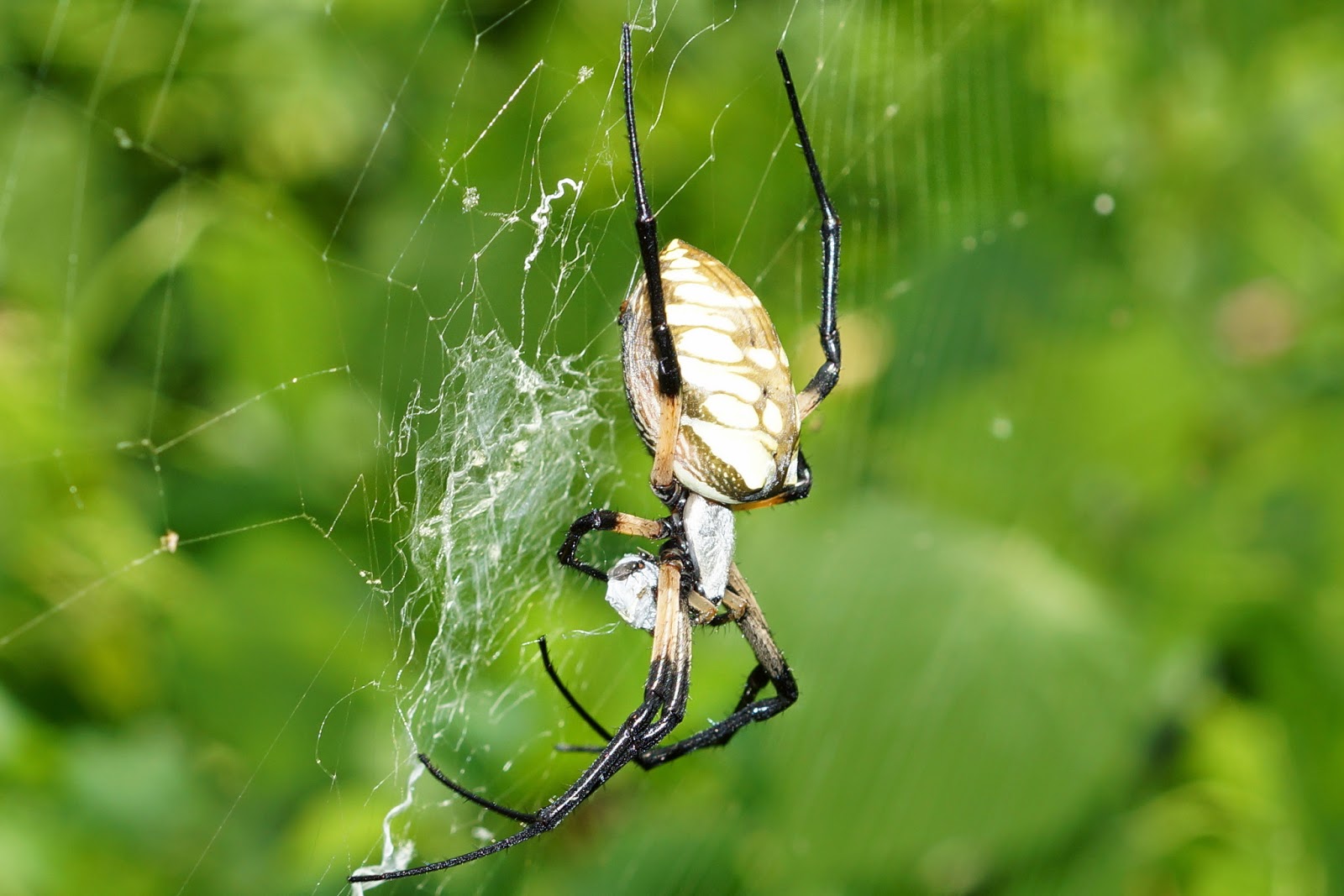
Although the wasp kept its distance, other insects were more willing to get close to the spider in order to get a meal. See if you can find them in the picture below.
The black-and-yellow argiope (Argiope aurantia) spider and its prey.
If they are too small to find in the picture above, this close-up should help.
Two small flies are sitting on the spider's wrapped-up prey.
The spider is clutching a prey item already wrapped in white silk -- and if you look closely on the left and top of the white package, you can see two very small flies. These appear to be freeloader flies (Milichiidae), which are often found in the seemingly hazardous occupation of feeding on the kills of spiders and other predators.
Spiders can be predators of wasps, but sometimes the relationship is reversed and the spider becomes the prey. This summer I watched a dramatic encounter that unfolded too quickly for me to capture on camera. A spider was sitting on a leaf at the end of a tree branch while a large wasp hunted nearby. As the wasp drew near, the spider edged away and then dropped down a thread to hang in mid-air. For a few moments, it appeared that the spider had escaped the wasp's attention -- but then the wasp struck. I had a brief glimpse of the wasp and spider grappling each other before they plummeted to the ground. By the time they landed, the spider was already paralyzed or dead.
Not all spiders are so easily subdued, however. Take, for example, the black-and-yellow argiope, one of the largest orbweaver spiders in North America (along with the giant lichen spider and the golden silk spider).
As I was photographing this very imposing spider, a wasp came up and hovered to inspect the spider too.
A wasp approaches the orbweaver spider.
If the disparity in size wasn't already enough to discourage the wasp from taking further action, a wave of the spider's legs seemed to complete the message.
The orbweaver spider waving its legs.
The wasp retreated, leaving the spider undisturbed.
Once I focused on the fact that there were multiple swallow species present, the wide variation in the placement, structure, and stage of the nests began to make sense.
The cliff swallow nests looked the most precarious; they opened outwards and hung where the bridge beams met the supporting columns (see here and here). These nests were also the furthest behind in development -- while the cliff swallows were still extending their nests and incubating their eggs, the other swallows were busy feeding their chicks.
The cave swallows had built their deep nests in the corners formed by perpendicular beams. Although I could not see into the nests, the steady stream of feeding visits by the parents was a good indication that there were growing chicks hidden inside.
* To see this video in high definition (1080p), you may need to:
(1) click "YouTube" to watch on the YouTube website
(2) change the settings at the bottom of the video screen
Meanwhile, the barn swallow chicks were quickly outgrowing their nests, which were shallow cups balanced on narrow ledges.
Four out of five barn swallow chicks agree: it is time for food!
These chicks eagerly watched each adult swallow that came nearby and opened their beaks wide for food, regardless of whether the adult was one of their parents or not. Since there were many nests under the bridge, the chicks' gaping, yellow mouths were ignored more often than not.
* To see this video in high definition (1080p), you may need to:
(1) click "YouTube" to watch on the YouTube website
(2) change the settings at the bottom of the video screen
Nevertheless, the chicks had soon gown enough to leave the nest and perch on a nearby beam. There, they continued to watch the all hardworking adults and to wait for food to be delivered.
A few days later, the chicks were out of the nest -- but still waiting around to be fed.